All of time
4.54 billion years on one wall, with today on the right. Each step left is ten times further back. Zoom in anywhere, and open anything for its story and its source.
The timeline
Events
Our cases
Human lineages
PlatesArt, hung by era. Not dated events.
You are here
Scroll or pinch to zoom, drag to move. With the keyboard: arrow keys move, + and − zoom, 0 shows all of time. Tab reaches every item; Enter opens it.
Everything on the wall, oldest first
- Event4.54 billion years agoThe Earth formsThe best estimate for the age of the Earth and the Solar System, from ancient lead and meteorites. Source: USGS, “Geologic Time: Age of the Earth”.
- EventAbout 4.4 billion years agoThe oldest known crystalA zircon grain from the Jack Hills of Western Australia forms. Atom-probe study confirmed its age in 2014. Source: Valley et al. (2014), “Hadean age for a post-magma-ocean zircon confirmed by atom-probe tomography”, Nature Geoscience.
- Event3.48 billion years agoEarly signs of lifeStromatolites, layered rock built by communities of microbes, in hot-spring deposits of the Dresser Formation, Pilbara, Western Australia. Source: UNSW Sydney (2017), “Oldest evidence of life on land found in 3.48 billion-year-old Australian rocks”.
- Event538.8 million years agoThe Cambrian beginsThe first period of the Phanerozoic, the eon we still live in. Source: International Commission on Stratigraphy, International Chronostratigraphic Chart (v2024/12).
- Event386 million years agoThe oldest known forestFossil tree roots in a quarry at Cairo, New York, from a forest that spread into Pennsylvania and beyond. Source: Cardiff University (2019), “Scientists uncover world’s oldest forest”.
- Event251.9 million years agoThe Great DyingThe Permian–Triassic extinction, the worst the Earth has known, closes the Permian. Source: International Commission on Stratigraphy, International Chronostratigraphic Chart (v2024/12)Natural History Museum, “The Triassic Period: the rise of the dinosaurs”.
- EventAbout 240 million years agoThe first dinosaursDinosaurs appear in the fossil record in the Triassic, probably as small two-legged predators. Source: Natural History Museum, “The Triassic Period: the rise of the dinosaurs”.
- EventAbout 143 million years agoThe Cretaceous beginsThe last period of the dinosaurs. Gallery 04's nodosaur lived in its early part, about 110 million years ago. Source: International Commission on Stratigraphy, International Chronostratigraphic Chart (v2024/12).
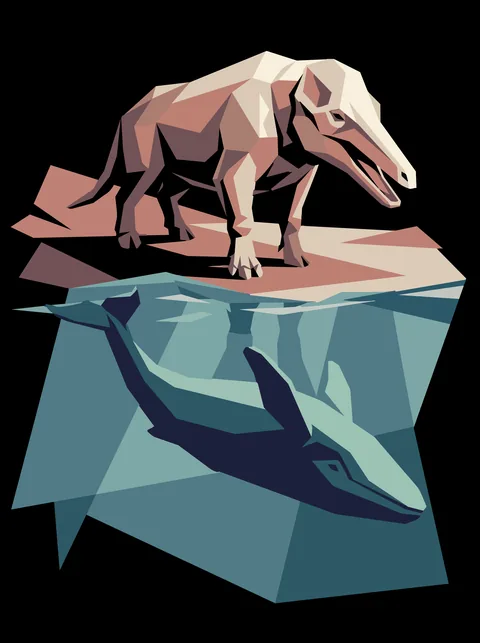
- Case110 to 112 million years agoThe dinosaur at the bottom of the seaIn 2011, a digger in a Canadian mine hit an armoured dinosaur in rock that had been seafloor. It was a land animal, and its last meal was still inside it.
- Event66 million years agoThe non-bird dinosaurs die outAn asteroid strikes the Earth; the dinosaurs that were not birds die out, with many other animals. Source: Natural History Museum, “How an asteroid ended the age of the dinosaurs”.
- Event3.3 million years agoThe oldest known stone toolsStone tools from Lomekwi 3, West Turkana, Kenya, 700,000 years older than the Oldowan tools once thought the first. Scholars had long supposed the genus Homo made the first tools. Source: Harmand et al. (2015), “3.3-million-year-old stone tools from Lomekwi 3, West Turkana, Kenya”, Nature.
- Event3.2 million years agoLucyAn adult female Australopithecus afarensis from Hadar, Ethiopia. She walked upright and could climb trees. Source: Smithsonian Human Origins, “Australopithecus afarensis”.
- Event2.58 million years agoThe Pleistocene beginsIt lasts until the Holocene begins, 11,700 years ago. Source: International Commission on Stratigraphy, International Chronostratigraphic Chart (v2024/12).
- EventBy about 1.9 million years agoHomo erectusThe earliest fossils of Homo erectus, the first early humans with body proportions like ours. Source: Smithsonian Human Origins, “Homo erectus”.
- LineageAbout 500,000 to 30,000 years ago, estimated from few fossils and DNADenisovansMost of what we know comes from DNA: the finger bone's genome, published in 2010, showed a kind of human no one had seen before.
- EventAbout 430,000 years agoThe Sima de los HuesosTwenty-eight people in a pit in Atapuerca, Spain. Their DNA puts them on the Neanderthal side of the family. Source: Meyer et al. (2016), “Nuclear DNA sequences from the Middle Pleistocene Sima de los Huesos hominins”, Nature.
- LineageAbout 400,000 to 40,000 years agoNeanderthalsThey were shorter and stockier than us, built for the cold, with brains as large as ours or larger.
- EventAbout 300,000 years agoThe oldest fossils of our speciesFossils from Jebel Irhoud in Morocco pushed the origin of Homo sapiens back by at least 100,000 years. Source: Smithsonian Human Origins, “Our species arose at least 300,000 years ago”.
- LineageAbout 300,000 years ago to todayHomo sapiensBy 164,000 years ago people were collecting and cooking shellfish, and by 90,000 years ago they were making fishing tools.
- EventMore than 200,000 years agoHomo sapiens outside AfricaThe back of a skull from Apidima Cave, Greece: the earliest Homo sapiens fossil found outside Africa so far. DNA shows many movements out of Africa, over hundreds of thousands of years. Source: Natural History Museum, “When and how did modern humans, Homo sapiens, spread out of Africa and around the world?”.
- Event80,000–140,000 years agoDennyA girl with a Neanderthal mother and a Denisovan father, known from one bone fragment in Denisova Cave, Siberia. Source: Slon et al. (2018), “The genome of the offspring of a Neanderthal mother and a Denisovan father”, NatureDouka et al. (2019), “Age estimates for hominin fossils and the onset of the Upper Palaeolithic at Denisova Cave”, Nature.
- LineageFossils about 100,000 to 60,000 years ago; its stone tools until about 50,000Homo floresiensisThey made stone tools and hunted Stegodon, a small elephant.
- EventAt least 67,800 years agoThe oldest known cave artA hand stencil in Liang Metanduno on Muna Island, off Sulawesi. The date is a minimum, from the mineral crust grown over the paint. Source: Oktaviana et al. (2026), “Rock art from at least 67,800 years ago in Sulawesi”, Nature.
- LineageAt least 50,000 to 67,000 years ago, by the dates published with the speciesHomo luzonensisIts teeth are small and look much like ours.
- EventBy about 54,000 years agoOur species reaches western EuropeA tooth from Grotte Mandrin in southern France. Neanderthals replaced this group soon after; Homo sapiens returned about 45,000 years ago. Source: Natural History Museum, “When and how did modern humans, Homo sapiens, spread out of Africa and around the world?”.
- CaseAbout 50,000 years agoWe weren't the only humansIn the Ice Age, Homo sapiens shared the world with at least four other human lineages.
- EventAbout 45,000–49,000 years agoOur ancestors and NeanderthalsThe mixing that left Neanderthal DNA in everyone whose ancestry is from outside Africa, dated from the earliest modern human genomes. Source: Sümer et al. (2024), “Earliest modern human genomes constrain timing of Neanderthal admixture”, Nature.
- EventBy about 40,000 years agoThe last NeanderthalsAll traces of Neanderthals disappear, within a few thousand years of modern humans moving into Europe. Source: Smithsonian Human Origins, “Homo neanderthalensis”.
- EventAt least 39,900 years agoA hand stencil in MarosDated in the caves of Maros, Sulawesi, in 2014, when it was the oldest known hand stencil in the world. Source: Aubert et al. (2014), “Pleistocene cave art from Sulawesi, Indonesia”, Nature.
- Event37,000–34,000 years agoDrawings in Chauvet CaveRadiocarbon dates on the charcoal of the black drawings put the first phase here. Source: LSCE (CNRS/CEA), “The Chauvet cave: 30 years since its discovery”.
- Event26,500 to about 19,000 years agoThe Last Glacial MaximumNearly all the world's ice sheets stand at their largest. Source: Clark et al. (2009), “The Last Glacial Maximum”, Science.
- Event21,000–23,000 years agoFootprints at White SandsHuman footprints in New Mexico, the oldest known in North America. The date was questioned; a 2023 study backed it. Source: USGS (2023), “Study confirms age of oldest fossil human footprints in North America”.
- Event11,700 years agoThe last glacial period endsThe Holocene, the present epoch, begins; its lower boundary is fixed in Greenland ice cores. Source: Britannica, “Holocene Epoch: the Pleistocene–Holocene boundary”.
- Event9600–8200 BCGöbekli TepeHunter-gatherers raise round stone enclosures with T-shaped pillars carved with wild animals, in south-eastern Anatolia. Source: UNESCO World Heritage, “Göbekli Tepe”.
- EventAbout 10,000 years agoMammoths cut off on WrangelRising seas make Wrangel Island. Fewer than ten mammoths are left on it; their descendants last another 6,000 years. Source: Stockholm University (2024), on the last mammoths of Wrangel Island.
- Event7400–6200 BCÇatalhöyükEighteen levels of a Neolithic town on the Anatolian plateau, with wall paintings and reliefs. Source: UNESCO World Heritage, “Neolithic Site of Çatalhöyük”.
- EventAbout 7,000 years agoCopper smelting at BelovodeCopper slag in Serbia: when it was published in 2010, the oldest securely dated evidence of copper making. Ötzi's axe, about 1,700 years later, is copper. Source: Science News (2010), “Serbian site may have hosted first copper makers”.
- EventAbout 6,000 years agoFarming reaches BritainFarming began in the Near East. It reached Britain with people whose ancestry traces back to the Aegean. Source: Natural History Museum (2019), “Neolithic Britain: where did the first farmers come from?”.
- EventAbout 3320–3200 BCThe first writingTags and labels from the tombs of Egypt's first kings, about 3320 BC; the earliest cuneiform tablets from Mesopotamia, about 3200 BC. Source: University of Chicago News (2010), “Origins of writing make for engaging new exhibition at Oriental Institute Museum”.
- CaseAbout 3300 BCWho killed Ötzi?In 1991, two hikers found a body in the Alpine ice. It was more than five thousand years old, and in 2001 an X-ray showed how the man died.
- EventAbout 3000–2500 BCStonehengeA circular ditch and banks about 3000 BC; the stones were set up in the centre about 2500 BC. Source: English Heritage, “History of Stonehenge”.
- Event2680–2560 BCThe pyramids at GizaEgypt’s Fourth Dynasty. Khufu, son of the dynasty’s founder Snefru, commissioned the Great Pyramid. Source: Smithsonian Institution, “The Egyptian Pyramid”.
- EventAbout 4,000 years agoThe last mammothsThe last woolly mammoths, on Wrangel Island off Siberia, die out. What caused it is still unknown. Source: Stockholm University (2024), on the last mammoths of Wrangel Island.
- Event331 BCAlexandria is foundedAlexander the Great founds a port city in northern Egypt and names it after himself. Source: World History Encyclopedia, “Alexandria”.
- EventUnder Ptolemy I, 323–282 BCThe Library of AlexandriaArgued No ancient account of the library's founding survives. Most scholars credit Ptolemy I, helped by Demetrios of Phaleron. Source: Roger S. Bagnall (2002), “Alexandria: Library of Dreams”, Proceedings of the American Philosophical SocietyWorld History Encyclopedia, “Library of Alexandria”.
- Event205 BCThe Antikythera mechanism's start dateArgued Its eclipse dial fits a start in 205 BC. It was built before the ship that carried it sank, about 65 BC. Source: Freeth (2014), “Eclipse Prediction on the Ancient Greek Astronomical Calculating Machine Known as the Antikythera Mechanism”, PLOS ONETony Freeth, “The Antikythera Mechanism”, World Archaeology.
- CaseThe wreck: about 70 to 60 BCThe lump that was a computerIn 1900, sponge divers sheltering from a storm off a Greek island found a wreck full of statues. Beside them lay a lump of bronze with gears inside.
- Event48 BCCaesar's fire in AlexandriaPlutarch, writing at least a century later, says the fire destroyed the great library. Argued: it more likely reached book warehouses on the docks. Source: The Open University, OpenLearn, “Plutarch, Life of Caesar 49” (trans. B. Perrin)Roger S. Bagnall (2002), “Alexandria: Library of Dreams”, Proceedings of the American Philosophical Society.
- Case48 BC to the 270s ADThe scroll that survived the fireLegend says Caesar's fire destroyed the Library of Alexandria. We follow a representative scroll, one like those the flames spared, and the case that slow neglect did what the fire couldn't.
- EventAD 79Vesuvius buries a libraryThe eruption carbonises the papyrus scrolls of a villa at Herculaneum, and preserves them. Source: Vesuvius Challenge, “Reading the Herculaneum scrolls”.
- Event2nd to 4th century ADThe codex replaces the rollBooks of pages bound at one edge slowly replace the papyrus roll; by the 4th century the codex has won. Sources differ on when it caught on. Source: University of Michigan Library, Papyrology Collection, “What is a codex?”University of Oxford Podcasts (Bodleian Libraries), “From roll to codex”.
- EventAD 391The Serapeum is destroyedA crowd of monks destroys the temple that later writers say held a second library. How old that library was is unknown. Source: Roger S. Bagnall (2002), “Alexandria: Library of Dreams”, Proceedings of the American Philosophical Society.
- Event1750The Villa of the Papyri is foundA farmworker digging a well at Herculaneum hits a marble pavement. Hundreds of carbonised scrolls come out. Source: Vesuvius Challenge, “Reading the Herculaneum scrolls”.
- EventAugust 1856Neanderthal 1Workers find bones in the Feldhofer Cave, Neander Valley, Germany: the first remains recognised as an early human fossil. Source: Neanderthal Museum, “History of the discovery of Neanderthal man”Smithsonian Human Origins, “Homo neanderthalensis”.
- EventSpring 1900Sponge divers find the Antikythera wreckSheltering from a storm, divers from Symi find a wreck full of statues. Source: Smithsonian Magazine, “Exploring the Titanic of the Ancient World”Tony Freeth, “The Antikythera Mechanism”, World Archaeology.
- EventMay 1902A gear in the lumpAt the National Archaeological Museum in Athens, a fragment in a box turns out to hold gears. Source: “The Forgotten Pioneer: Valerios Stais and his research in Kythera, Antikythera and Thessaly”, Bulletin of the History of Archaeology.
- Event1946Radiocarbon dating proposedWillard Libby proposes dating once-living things by the carbon-14 left in them. Source: American Chemical Society, “Discovery of Radiocarbon Dating”.
- Event1949Radiocarbon dating testedArnold and Libby check the method against samples whose ages are already known. Source: Arnold and Libby (1949), “Age Determinations by Radiocarbon Content: Checks with Samples of Known Age”, Science.
- Event1960A Nobel Prize for radiocarbonWillard Libby wins the chemistry prize for using carbon-14 to date things in archaeology and geology. Source: The Nobel Prize in Chemistry 1960.
- Event1980Iridium at the boundaryA spike of iridium in the rock laid down as the dinosaurs died out leads the Alvarez team to propose an impact from space. Source: Alvarez, Alvarez, Asaro and Michel (1980), “Extraterrestrial Cause for the Cretaceous-Tertiary Extinction”, Science.
- Event19 September 1991Ötzi is foundTwo hikers find a body in the ice near Tisenjoch, in the Ötztal Alps. Source: South Tyrol Museum of Archaeology, “The discovery”.
- Event18 December 1994Chauvet Cave is foundAt Vallon-Pont-d'Arc in the Ardèche, France. Its black drawings were later radiocarbon-dated to 37,000–34,000 years ago. Source: LSCE (CNRS/CEA), “The Chauvet cave: 30 years since its discovery”.
- Event2001An arrowhead in Ötzi's shoulderA routine X-ray finds a stone arrowhead in his left shoulder, ten years after he was found. Source: Pernter et al. (2007), “Radiologic proof for the Iceman's cause of death”, Journal of Archaeological Science.
- Event2004Homo floresiensis is namedFound in Liang Bua cave, Flores, in 2003; described as a new human species in 2004. Source: Brown et al. (2004), “A new small-bodied hominin from the Late Pleistocene of Flores, Indonesia”, NatureNatural History Museum, “Homo floresiensis”.
- Event2005The mechanism in CTX-ray CT of all 82 fragments decodes the gearing at the back and reveals inscriptions hidden inside. Source: Freeth et al. (2021), “A Model of the Cosmos in the ancient Greek Antikythera Mechanism”, Scientific Reports.
- Event2010A Neanderthal genome, and the DenisovansSvante Pääbo's team publishes the first Neanderthal genome, and DNA from a finger bone found in Denisova Cave in 2008 reveals a human lineage no one knew. Source: The Nobel Prize in Physiology or Medicine 2022, press releaseKrause et al. (2010), “The complete mitochondrial DNA genome of an unknown hominin from southern Siberia”, Nature.
- Event21 March 2011A digger hits a dinosaurShawn Funk's excavator strikes an armoured dinosaur in the Millennium Mine, Alberta. Source: National Geographic (2017), “The Amazing Dinosaur Found (Accidentally) by Miners in Canada”.
- Event2017Borealopelta is namedAfter years of preparation, the nodosaur is described as a new species, with its skin and scales preserved. Source: Brown et al. (2017), “An Exceptionally Preserved Three-Dimensional Armored Dinosaur…”, Current Biology.
- Event2019Homo luzonensis is namedTeeth and bones from Callao Cave, Luzon, described as a new human species. Source: Détroit et al. (2019), “A new species of Homo from the Late Pleistocene of the Philippines”, Nature.
- Event2020The nodosaur's last mealIts stomach contents turn out to be mostly fern leaves. Source: University of Saskatchewan (2020), on what Borealopelta ate for its last meal.
- EventFebruary 2024A buried scroll is readMachine learning on X-ray CT scans recovers more than 2,000 characters from a Herculaneum scroll that has never been opened. Source: Vesuvius Challenge (2024), “2023 Grand Prize awarded”.
- Event2025A face for the Denisovans?Argued Proteins and mitochondrial DNA tie the Harbin skull from north-east China to the Denisovans. Source: Fu et al. (2025), “The proteome of the late Middle Pleistocene Harbin individual”, ScienceFu et al. (2025), “Denisovan mitochondrial DNA from dental calculus of the >146,000-year-old Harbin cranium”, Cell.
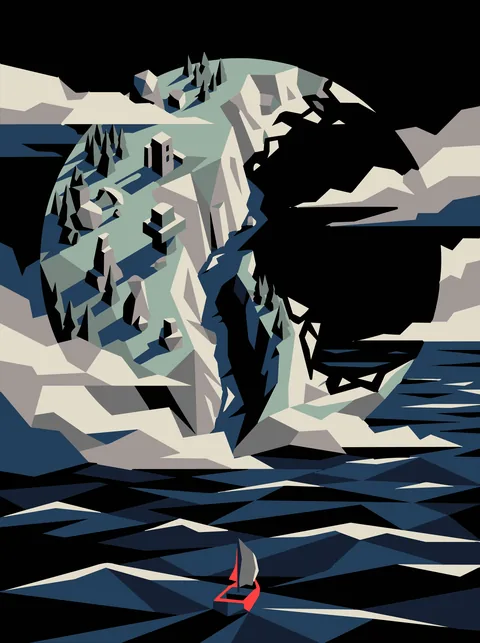
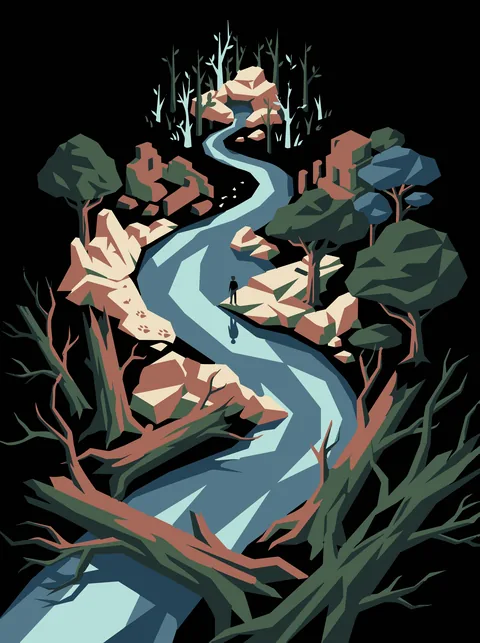
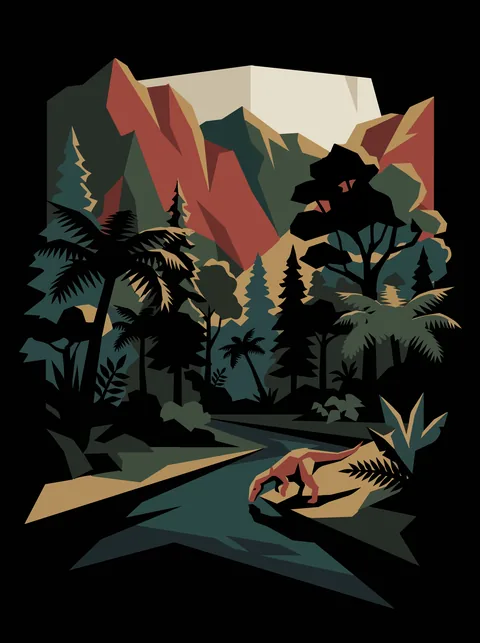
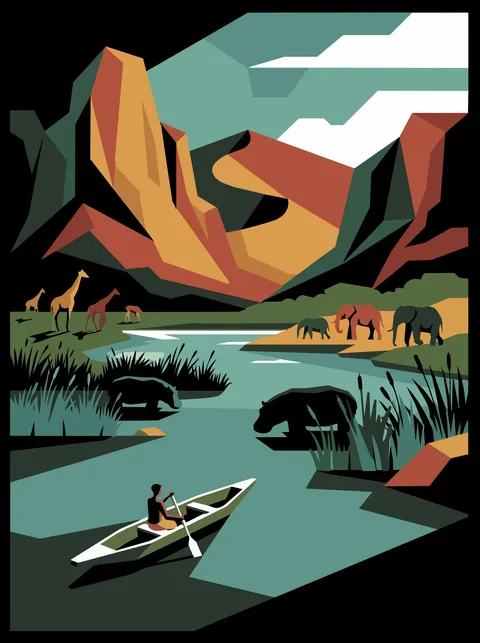
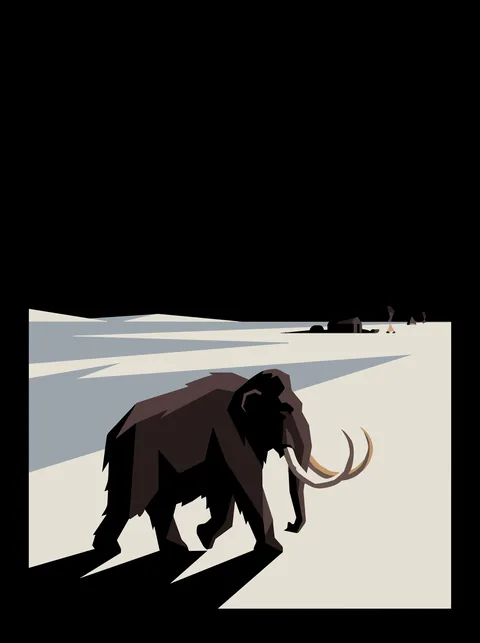
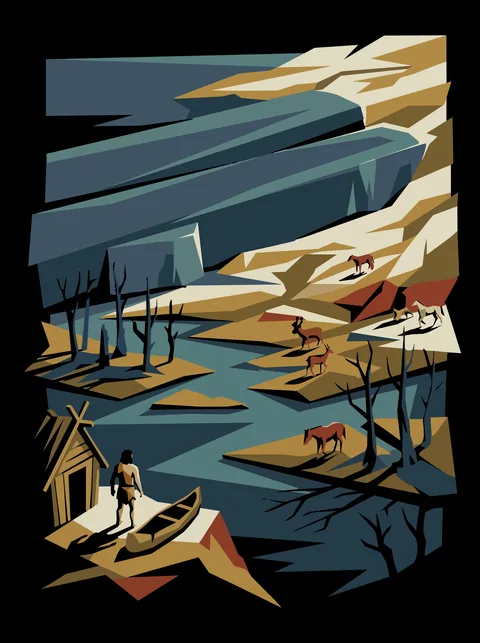
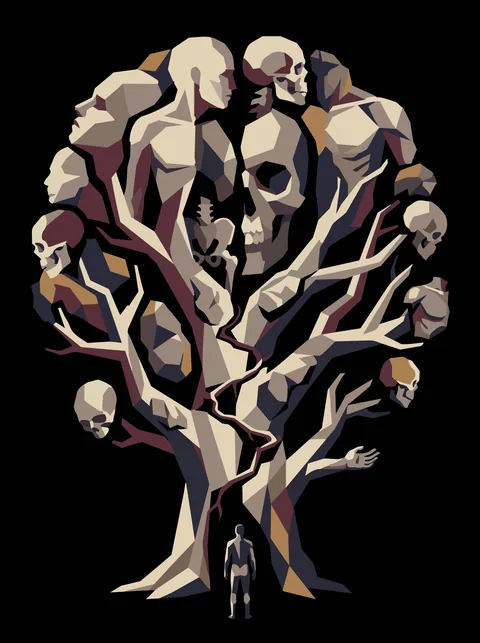
The plates
Our twenty plates are art, not dated events. They hang on the wall by era.



Sources
Dates for the events come from these pages. The lineages' dates are the ones on the home page's globe, with its sources; each case lists its own. The eras are the ones used across the site.
All 71 source pages, by era
Deep time
- USGS, “Geologic Time: Age of the Earth”
- Valley et al. (2014), “Hadean age for a post-magma-ocean zircon confirmed by atom-probe tomography”, Nature Geoscience
- UNSW Sydney (2017), “Oldest evidence of life on land found in 3.48 billion-year-old Australian rocks”
- International Commission on Stratigraphy, International Chronostratigraphic Chart (v2024/12)
- Cardiff University (2019), “Scientists uncover world’s oldest forest”
- Natural History Museum, “The Triassic Period: the rise of the dinosaurs”
- Natural History Museum, “How an asteroid ended the age of the dinosaurs”
- Harmand et al. (2015), “3.3-million-year-old stone tools from Lomekwi 3, West Turkana, Kenya”, Nature
- Smithsonian Human Origins, “Australopithecus afarensis”
The Ice Age
- Smithsonian Human Origins, “Homo erectus”
- Meyer et al. (2016), “Nuclear DNA sequences from the Middle Pleistocene Sima de los Huesos hominins”, Nature
- Smithsonian Human Origins, “Our species arose at least 300,000 years ago”
- Natural History Museum, “When and how did modern humans, Homo sapiens, spread out of Africa and around the world?”
- Slon et al. (2018), “The genome of the offspring of a Neanderthal mother and a Denisovan father”, Nature
- Douka et al. (2019), “Age estimates for hominin fossils and the onset of the Upper Palaeolithic at Denisova Cave”, Nature
- Oktaviana et al. (2026), “Rock art from at least 67,800 years ago in Sulawesi”, Nature
- Sümer et al. (2024), “Earliest modern human genomes constrain timing of Neanderthal admixture”, Nature
- Smithsonian Human Origins, “Homo neanderthalensis”
- Aubert et al. (2014), “Pleistocene cave art from Sulawesi, Indonesia”, Nature
- LSCE (CNRS/CEA), “The Chauvet cave: 30 years since its discovery”
- Clark et al. (2009), “The Last Glacial Maximum”, Science
- USGS (2023), “Study confirms age of oldest fossil human footprints in North America”
Before writing
- Britannica, “Holocene Epoch: the Pleistocene–Holocene boundary”
- UNESCO World Heritage, “Göbekli Tepe”
- Stockholm University (2024), on the last mammoths of Wrangel Island
- UNESCO World Heritage, “Neolithic Site of Çatalhöyük”
- Science News (2010), “Serbian site may have hosted first copper makers”
- Natural History Museum (2019), “Neolithic Britain: where did the first farmers come from?”
- University of Chicago News (2010), “Origins of writing make for engaging new exhibition at Oriental Institute Museum”
Written history
- English Heritage, “History of Stonehenge”
- Smithsonian Institution, “The Egyptian Pyramid”
- World History Encyclopedia, “Alexandria”
- Roger S. Bagnall (2002), “Alexandria: Library of Dreams”, Proceedings of the American Philosophical Society
- World History Encyclopedia, “Library of Alexandria”
- Freeth (2014), “Eclipse Prediction on the Ancient Greek Astronomical Calculating Machine Known as the Antikythera Mechanism”, PLOS ONE
- Tony Freeth, “The Antikythera Mechanism”, World Archaeology
- The Open University, OpenLearn, “Plutarch, Life of Caesar 49” (trans. B. Perrin)
- Vesuvius Challenge, “Reading the Herculaneum scrolls”
- University of Michigan Library, Papyrology Collection, “What is a codex?”
- University of Oxford Podcasts (Bodleian Libraries), “From roll to codex”
- Neanderthal Museum, “History of the discovery of Neanderthal man”
- Smithsonian Magazine, “Exploring the Titanic of the Ancient World”
- “The Forgotten Pioneer: Valerios Stais and his research in Kythera, Antikythera and Thessaly”, Bulletin of the History of Archaeology
- American Chemical Society, “Discovery of Radiocarbon Dating”
- Arnold and Libby (1949), “Age Determinations by Radiocarbon Content: Checks with Samples of Known Age”, Science
- The Nobel Prize in Chemistry 1960
- Alvarez, Alvarez, Asaro and Michel (1980), “Extraterrestrial Cause for the Cretaceous-Tertiary Extinction”, Science
- South Tyrol Museum of Archaeology, “The discovery”
- Pernter et al. (2007), “Radiologic proof for the Iceman's cause of death”, Journal of Archaeological Science
- Brown et al. (2004), “A new small-bodied hominin from the Late Pleistocene of Flores, Indonesia”, Nature
- Natural History Museum, “Homo floresiensis”
- Freeth et al. (2021), “A Model of the Cosmos in the ancient Greek Antikythera Mechanism”, Scientific Reports
- The Nobel Prize in Physiology or Medicine 2022, press release
- Krause et al. (2010), “The complete mitochondrial DNA genome of an unknown hominin from southern Siberia”, Nature
- National Geographic (2017), “The Amazing Dinosaur Found (Accidentally) by Miners in Canada”
- Brown et al. (2017), “An Exceptionally Preserved Three-Dimensional Armored Dinosaur…”, Current Biology
- Détroit et al. (2019), “A new species of Homo from the Late Pleistocene of the Philippines”, Nature
- University of Saskatchewan (2020), on what Borealopelta ate for its last meal
- Vesuvius Challenge (2024), “2023 Grand Prize awarded”
- Fu et al. (2025), “The proteome of the late Middle Pleistocene Harbin individual”, Science
- Fu et al. (2025), “Denisovan mitochondrial DNA from dental calculus of the >146,000-year-old Harbin cranium”, Cell
Human lineages
- Australian Museum, Denisovans, on Denisovans
- Natural History Museum, Neanderthals, on Neanderthals
- Australian Museum, Neanderthals, on Neanderthals
- Smithsonian, Homo sapiens, on Homo sapiens
- Australian Museum, Homo sapiens, on Homo sapiens
- Smithsonian, Homo floresiensis, on Homo floresiensis
- Australian Museum, Homo floresiensis, on Homo floresiensis
- Natural History Museum, Homo luzonensis, on Homo luzonensis
- Journal of Human Evolution (2022), Homo luzonensis, on Homo luzonensis
- Quaternary Science Reviews (2023), Homo luzonensis, on Homo luzonensis