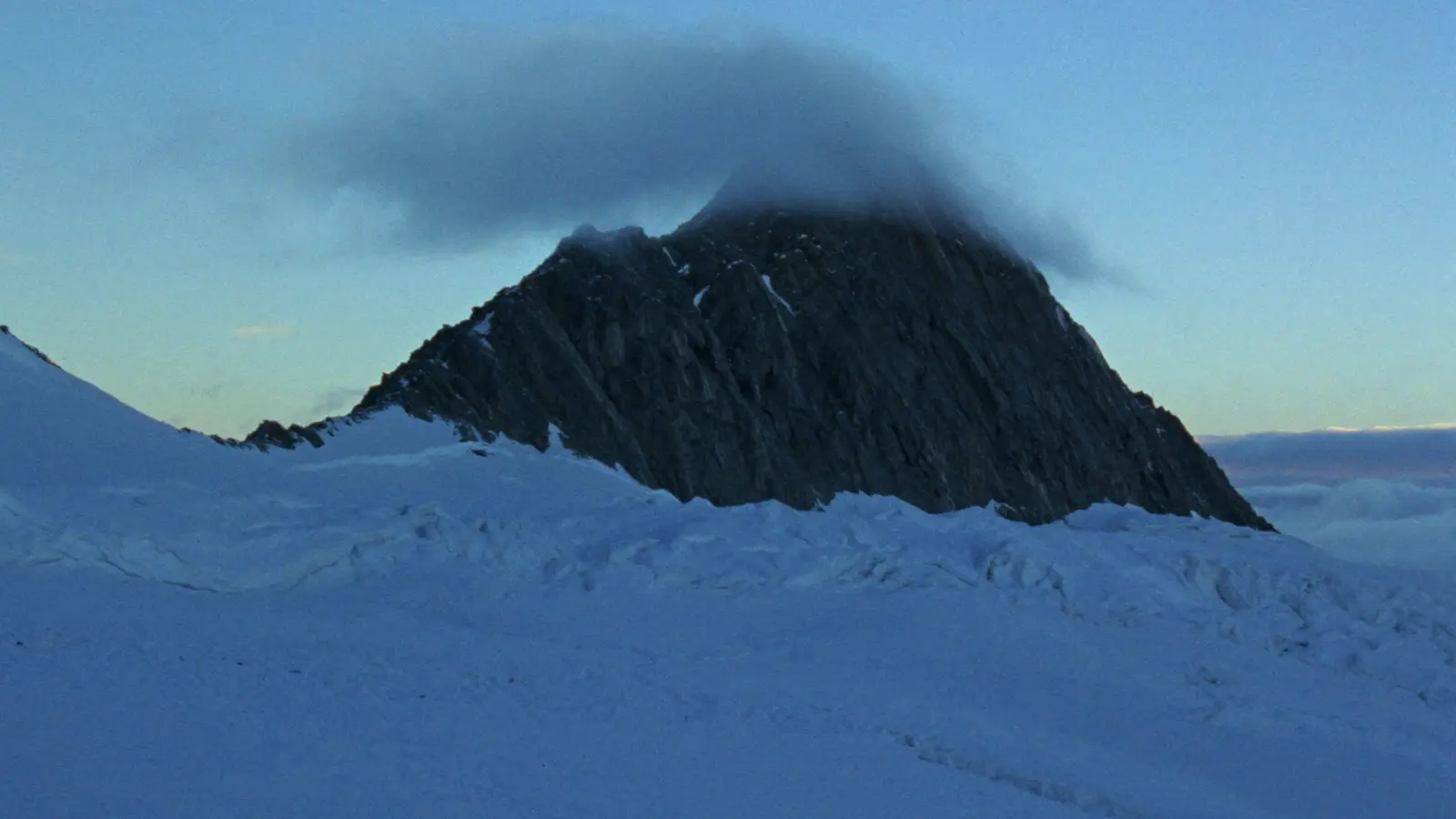
c. 3300 BC
Ötztal Alps
Gallery 01 · Who killed Ötzi?
Gallery 01 · The Copper Age
Who killed Ötzi?
In 1991, two hikers found a body in the Alpine ice. It was more than five thousand years old, and in 2001 an X-ray showed how the man died.
- Subject
- Archaeology
- Era
- Copper Age
- Place
- Ötztal Alps
- Format
- Reel · 60 s
Gallery 01 · Room 1
The film
The script
September, 1991. Two hikers, high in the Alps, spot something frozen in the ice.
A body. Police assume it’s a climber who died recently.
They’re off by more than five thousand years.
This man lived before Stonehenge. Before the pyramids.
He became known as Ötzi. And for ten years, scientists believed he had simply frozen to death.
Then, in 2001, an X-ray revealed something hidden in his shoulder.
A stone arrowhead. It had torn through an artery. He likely bled to death within minutes.
He’d eaten a full meal shortly before. The arrow came from behind.
His killer left a valuable copper axe behind; we read that as a sign this wasn’t a robbery.
Five thousand years later, we know how he died. Who did it may never be known.
What we flag in the script
- Some lines are worded more carefully here than in the film. The narration says “He felt safe”, calls the axe “priceless”, says “This wasn’t a robbery” and ends “We’ll never know who did it”. The captions follow the narration. The first three are our reading of the evidence, not findings. The South Tyrol Museum of Archaeology asks why his attacker took none of his equipment, when the axe alone must have been of enormous value, and whether something was taken that we don’t know about. Who shot him, and why, is not known.
Gallery 01 · Room 2 · In the case
Flint and copper
The arrow's flint head is still in his shoulder, and his killer left his copper axe behind. Ötzi's own things are in Bolzano. These two are from other museums: a flint arrowhead from the same long stretch of prehistory, and a copper blade made a few centuries after him.
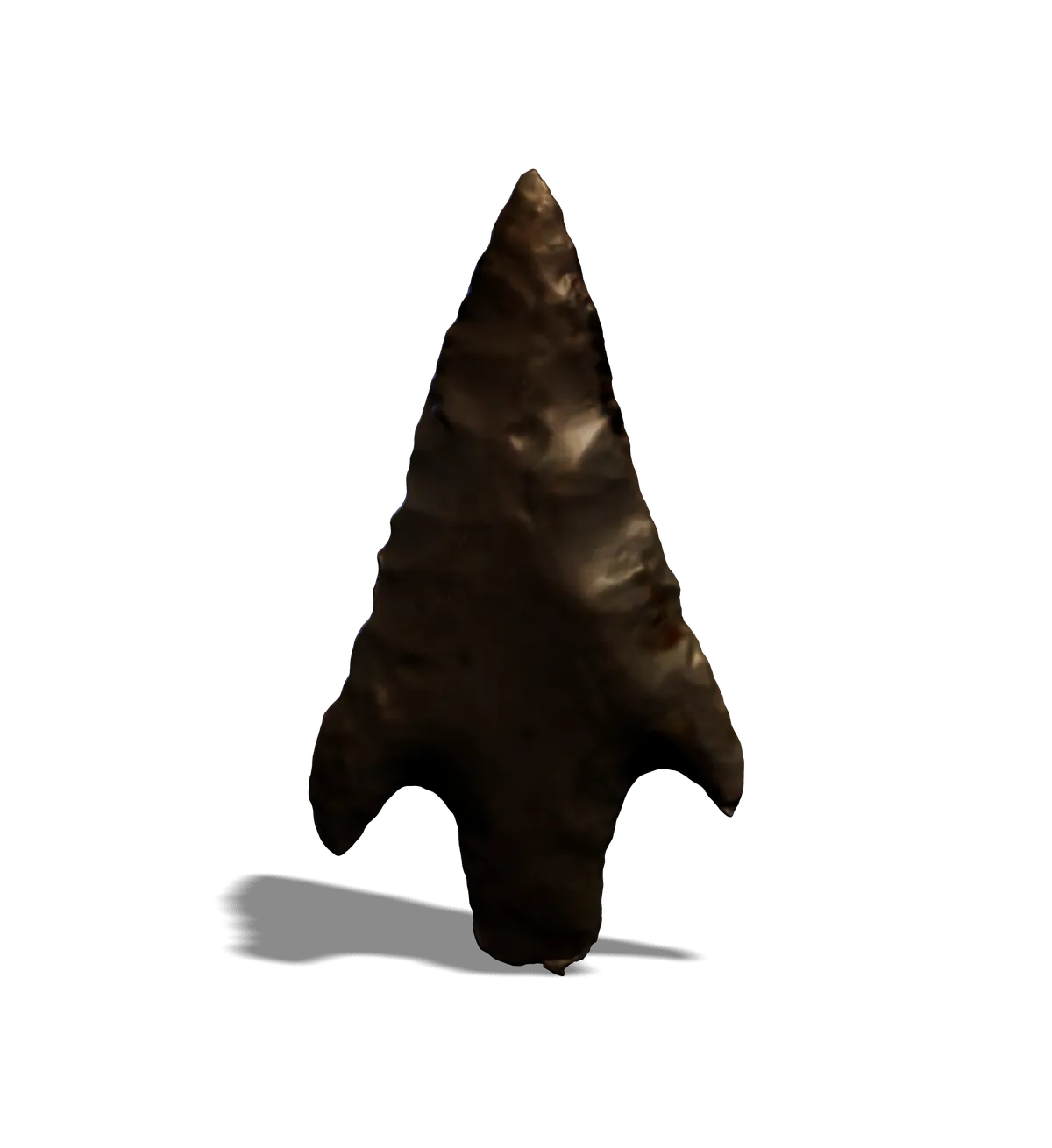
A small flint arrowhead, grey-brown and chipped all over, with two short barbs and a longer stem at its base.
Comparable object, not Ötzi's
Barbed and tanged flint arrowhead
- Object
- Arrowhead, 6.3 × 3.4 cm
- Date
- Neolithic, 5th to 3rd millennium BC
- Place
- Europe; the site is not given in the museum's record
- Material
- Flint
- Collection
- The Hunt Museum, Limerick, HCA 037
A flint point about the length of a thumb. The one that killed Ötzi is also flint, and its shape matches other flint arrowheads from the area, including the ones he carried himself.
The tang
The stem at the base went into the arrow shaft. On Ötzi's two finished arrows the flint heads are fixed to the shaft and bound with plant fibres. Source: South Tyrol Museum of Archaeology, equipment.
The barbs
The museum describes it as barbed and tanged, with barbs much shorter than the tang. Source: The Hunt Museum, Limerick, HCA 037.
Flaked by hand
The surface shows flaking. Ötzi carried a retoucheur, an antler-tipped tool for shaping and resharpening flint blades. Source: South Tyrol Museum of Archaeology, equipment.
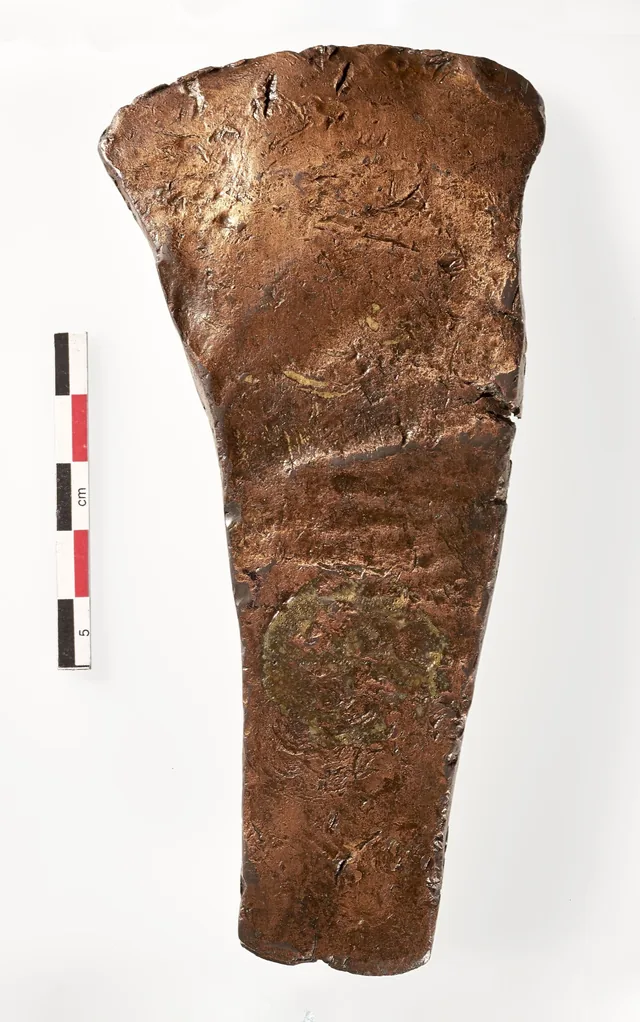
A flat copper axe blade photographed from above on white, widening from a narrow butt to a broad cutting edge, its surface dented and scratched, with a centimetre scale beside it.
Comparable object, not Ötzi's
Flat copper axe blade
- Object
- Axe blade
- Date
- 2800 to 1900 BC
- Place
- Not given in the museum's online record
- Material
- Copper
- Collection
- National Museum of Archaeology, History and Art, Luxembourg, 2005-091/001
A flat blade of copper, made at least five centuries after Ötzi died. His blade is flat and trapezoidal too, 99.7% copper, cast in a mould and hammered, and fixed into a forked yew haft with birch tar and leather straps.
The cutting edge
The wide end did the work. Ötzi's blade shows wear from frequent use and had to be resharpened. Source: South Tyrol Museum of Archaeology, equipment.
The butt
The narrow end sat in the haft. On Ötzi's axe it is held in a fork of yew with birch tar and bound with leather. Source: South Tyrol Museum of Archaeology, equipment.
The scale
The museum's photograph carries its own scale in centimetres. Source: MNHA Luxembourg, via Europeana.
Gallery 01 · Room 3 · Hands on
Read the X-ray
For ten years, scientists believed he had frozen to death. In 2001 an X-ray showed something hidden in his shoulder. Raise the contrast to find it, then follow what it did.
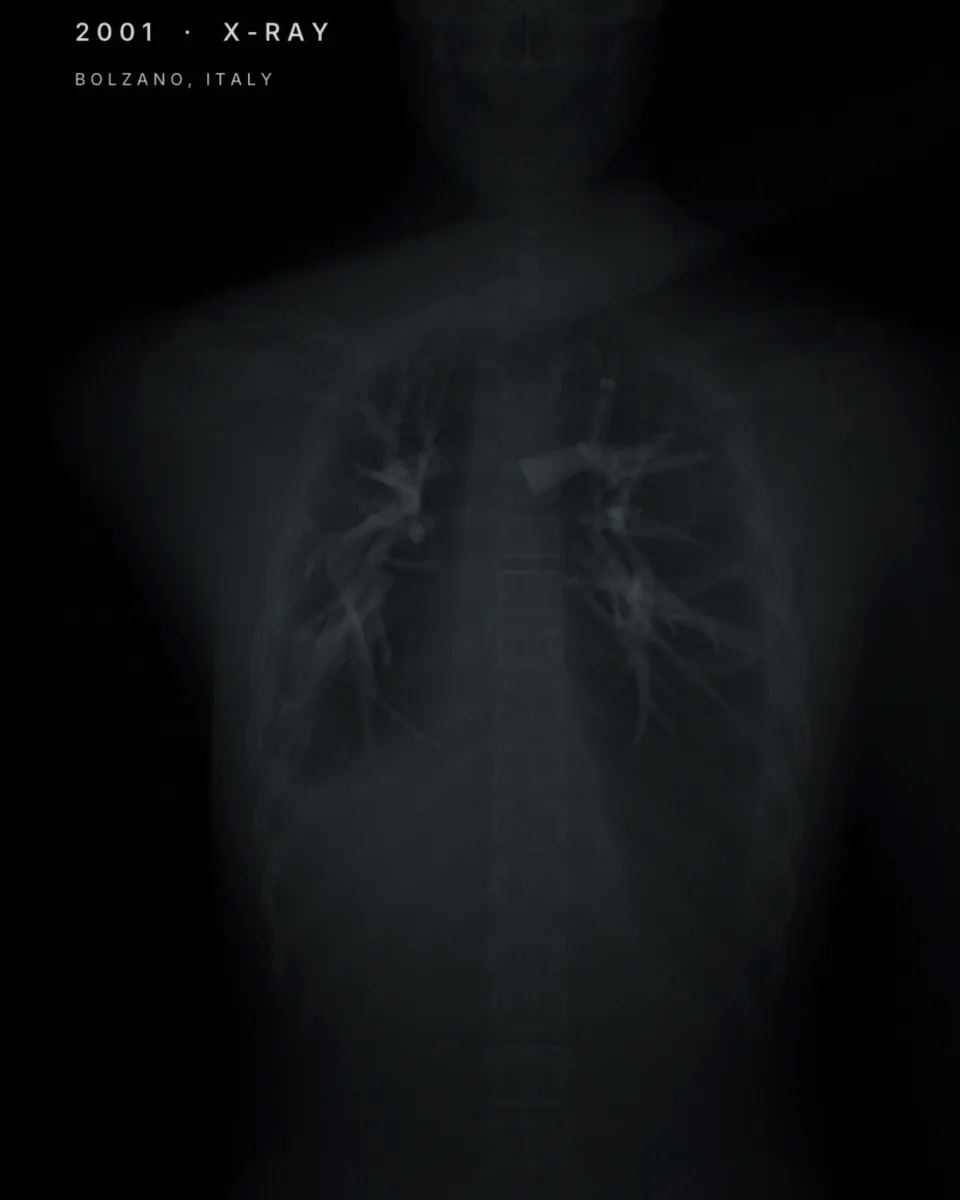
The film is a reconstruction from our reel, built with BodyParts3D anatomy, not the 2001 X-ray. The marks are drawn by us; their positions are approximate.
What they thought At first it was thought he had died in an accident in the mountains. For ten years, scientists believed he had simply frozen to death.
Known An X-ray showed a flint arrowhead in his left shoulder. Raise the contrast until it shows.
Known After the X-ray, a 2 cm entry wound was found in his back. The arrow came from behind.
Known The arrow severed the subclavian artery. He likely bled to death within minutes.
Known He also had a severe head injury, probably from the same time: a fall, or a blow.
Known The arrowhead broke off when the shaft was pulled out, and it is still in his body. Its shape matches other flint arrowheads from the area, including the ones he carried himself.
Argued Who pulled the shaft out: perhaps he did, perhaps his killer.
Our reading His killer left the copper axe behind. The museum asks why his attacker took none of his equipment; our film reads it as a sign this wasn't a robbery.
Open Who shot him, and why, is not known. A few days earlier he had been in a fight and cut his right hand deeply.
Sources: South Tyrol Museum of Archaeology, “The body”: the death; South Tyrol Museum of Archaeology, equipment.
Gallery 01 · Room 4 · Reconstructions
Stills from the reel
Frames from the film: reconstructions and illustrations, not photographs of the objects. Tap or hover to look closer.
01 The findSeptember 1991. Two hikers, high in the Alps, spot something frozen in the ice. 02 The X-ray2001. An X-ray reveals something hidden in his shoulder. 03 The arrowheadA stone arrowhead. It had torn through an artery.
Records
Sources used in the fact-check, and for this gallery
Credits
- 3D reconstructions, narration and score: Then & Theory / Alterra Editions.
- Similaun with Niederjochferner, photo by Stefan.straub, CC BY 4.0 (animated in 2.5D).
- Stonehenge, photo by Simon Banton, CC BY-SA 4.0.
- Giza pyramids, photo by Ricardo Liberato, CC BY-SA 2.0.
- Ötzi memorial at the find site (Tisenjoch), photo by Tigerente, CC BY-SA 4.0.
- Anatomy for the X-ray: BodyParts3D 4.0, DBCLS, CC BY 4.0.
- Rock models, textures and HDRIs: Poly Haven and ambientCG, CC0. Map data: Natural Earth, public domain.
- Barbed and tanged flint arrowhead: 3D scan: The Hunt Museum, via Sketchfab (CC BY 4.0). Museum record.
- Flat copper axe blade: Photograph: MNHA Luxembourg (Public Domain Mark 1.0). Museum record.