110 million years ago
Alberta, Canada
Gallery 04 · The dinosaur at the bottom of the sea
Gallery 04 · The Cretaceous
The dinosaur at the bottom of the sea
In 2011, a digger in a Canadian mine hit an armoured dinosaur in rock that had been seafloor. It was a land animal, and its last meal was still inside it.
- Subject
- Palaeontology
- Era
- Cretaceous
- Place
- Alberta, Canada
- Format
- Reel · 60 s
Gallery 04 · Room 1
The film
The script
A digger in a Canadian mine, far from any ocean, hits a dinosaur.
Armour plates spill out onto the ground, still locked in rock.
But 110 million years ago, this rock was seafloor. And this dinosaur lived on land.
So it came here dead, carried off by a river.
Gas swelled the rotting body. It floated out to sea, belly up.
For days it drifted. Then it burst, and sank on its back into the mud.
The mud buried it fast, before anything could eat it.
Even its stomach survived: a lump the size of a soccer ball.
Inside were chewed ferns, and flecks of charcoal.
Charcoal means fire. And after a fire, ferns are often the first plants back.
So it was grazing a burned forest, on new ferns rising from the ash.
No one knows what killed it. But 110 million years later, its last meal is still inside it.
What we flag in the script
- How it reached the sea is the majority view. National Geographic, the Royal Tyrrell Museum, the 2018 “bloat-and-float” study (Mallon and colleagues) and the research team’s own coverage describe a carcass that was already dead and floating. Larramendi, Paul and Hsu (2020) doubted it: they argued that ankylosaurs were too dense to float that way, and that this one was washed out to sea and drowned. Our fact-check couldn’t open that paper, so this is how Wikipedia reports it.
- Who, where and when. The dinosaur is the armoured nodosaur Borealopelta. The digger’s operator was Shawn Funk, at the Millennium Mine in Alberta, on 21 March 2011. The rock is 110 to 112 million years old, marine rock of the Clearwater Formation.
- The stomach. About 88% of it is chewed leaf material, mostly fern, and about 6% is charcoal.
- The season is left out. The sources don’t agree on it: one says early to mid-summer, another late spring to mid-summer.
Gallery 04 · Room 2 · In the case
A shell from the same seas
The nodosaur sank into a sea of the Albian, a stage of the Early Cretaceous. Ammonites swam in seas of that age. This one is a real fossil, scanned in 3D by the Paleontological Research Institution.
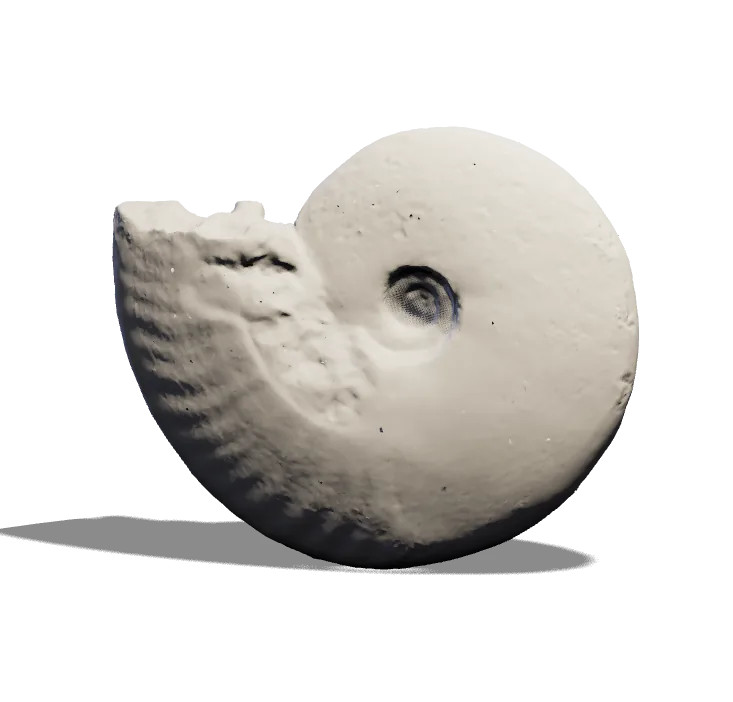
A flat, coiled fossil shell about the size of a palm, pale grey, with a small central hollow and faint curved ribs across the outer whorl.
Fossil, scanned in 3D
An ammonite from the nodosaur's age
- Object
- Cleoniceras besairiei, an ammonite
- Date
- Early Cretaceous, Albian stage
- Place
- Not given in the museum's record
- Material
- Fossil shell, about 12 cm across
- Collection
- Paleontological Research Institution, Ithaca, New York, PRI 70601
Cleoniceras lived in the Albian, the stage of the Early Cretaceous that also holds our nodosaur. Ammonites are extinct relatives of octopus and squid, and swam in seas like the one it sank into.
Built in chambers
As an ammonite grew, it moved its whole body into a new, larger chamber of the shell and sealed off the old one with a wall, a septum. Source: Natural History Museum, “What is an ammonite?”.
A clock in the rock
Ammonites were common and evolved fast, so they help date the rocks they are found in. Much of Europe's Mesozoic rock is divided into ammonite zones. Source: Natural History Museum, “What is an ammonite?”.
When
The Albian stage runs from 113.2 to 100.5 million years ago. Source: International Commission on Stratigraphy, International Chronostratigraphic Chart (2026/06).
3D model: Emily Hauf, Paleontological Research Institution · CC0 1.0
Gallery 04 · Room 3 · Reconstructions
Stills from the reel
Frames from the film: reconstructions and illustrations, not photographs of the objects. Tap or hover to look closer.
01 The findMarch 2011. Armour plates spill out onto the ground, still locked in rock. 02 Belly upGas swelled the rotting body. It floated out to sea, belly up. 03 The last mealIts stomach survived too: a lump the size of a soccer ball, holding chewed ferns and flecks of charcoal.
Records
Sources used in the fact-check, and for this gallery
- National Geographic (2017), “The Amazing Dinosaur Found (Accidentally) by Miners in Canada”
- National Geographic (2020), “Armored dinosaur's last meal fossilized in stunning detail”
- University of Saskatchewan (2020), on what Borealopelta ate for its last meal
- Brandon University Research Connection, “An armored dinosaur's last supper”
- Royal Tyrrell Museum (2018), on the upside-down preservation of ankylosaurs
- ScienceDaily (2018), “‘Bloat-and-float’ explains belly-up ankylosaur fossils”
- Science News Explores, “Fossil stomach reveals a dinosaur's last meal”
- The Canadian Encyclopedia, “Borealopelta”
- Wikipedia, “Borealopelta”
- Natural History Museum, “What is an ammonite?”
- International Commission on Stratigraphy, International Chronostratigraphic Chart (2026/06)
Credits
- Scenes built in Blender and animated from our own frames with generated video (Kling, via Higgsfield): Then & Theory / Alterra Editions. Everything on screen is a reconstruction, not footage.
- The dinosaur, the mining shovel and the fossil are generated 3D models (Higgsfield and Meshy image-to-3D). The fossil is stylised after the Royal Tyrrell Museum's display, not a scan of it.
- Narration: ElevenLabs voice “George”. Score: generated with ACE-Step 1.5 (model under the MIT licence).
- Plants and wood from Poly Haven, CC0: Fir Tree 01 and Fern 02 (Rob Tuytel, Rico Cilliers), Dead Tree Trunk and Tree Stump 01 (Rob Tuytel), Dead Tree Trunk 02 (Jenelle van Heerden, Rico Cilliers).
- Ground and rock textures from Poly Haven, CC0: Excavated Soil Wall (Amal Kumar); Coral Mud 01, Brown Mud 02, Burned Ground 01 and Dry Ground 01 (Rob Tuytel); Forest Ground 04 (Rob Tuytel, Rico Cilliers); Rock Face 03 (Dario Barresi, Rico Cilliers).
- Sky: Kloofendal 38d Partly Cloudy (Pure Sky), Greg Zaal and Jarod Guest, Poly Haven, CC0.
- An ammonite from the nodosaur's age: 3D model: Emily Hauf, Paleontological Research Institution (CC0 1.0). Museum record.