1st century BC
Antikythera, Greece
Gallery 05 · The lump that was a computer
Gallery 05 · 1st century BC
The lump that was a computer
In 1900, sponge divers sheltering from a storm off a Greek island found a wreck full of statues. Beside them lay a lump of bronze with gears inside.
- Subject
- Archaeology
- Era
- 1st century BC
- Place
- Antikythera, Greece
- Format
- Reel · 55 s
Gallery 05 · Room 1
The film
The script
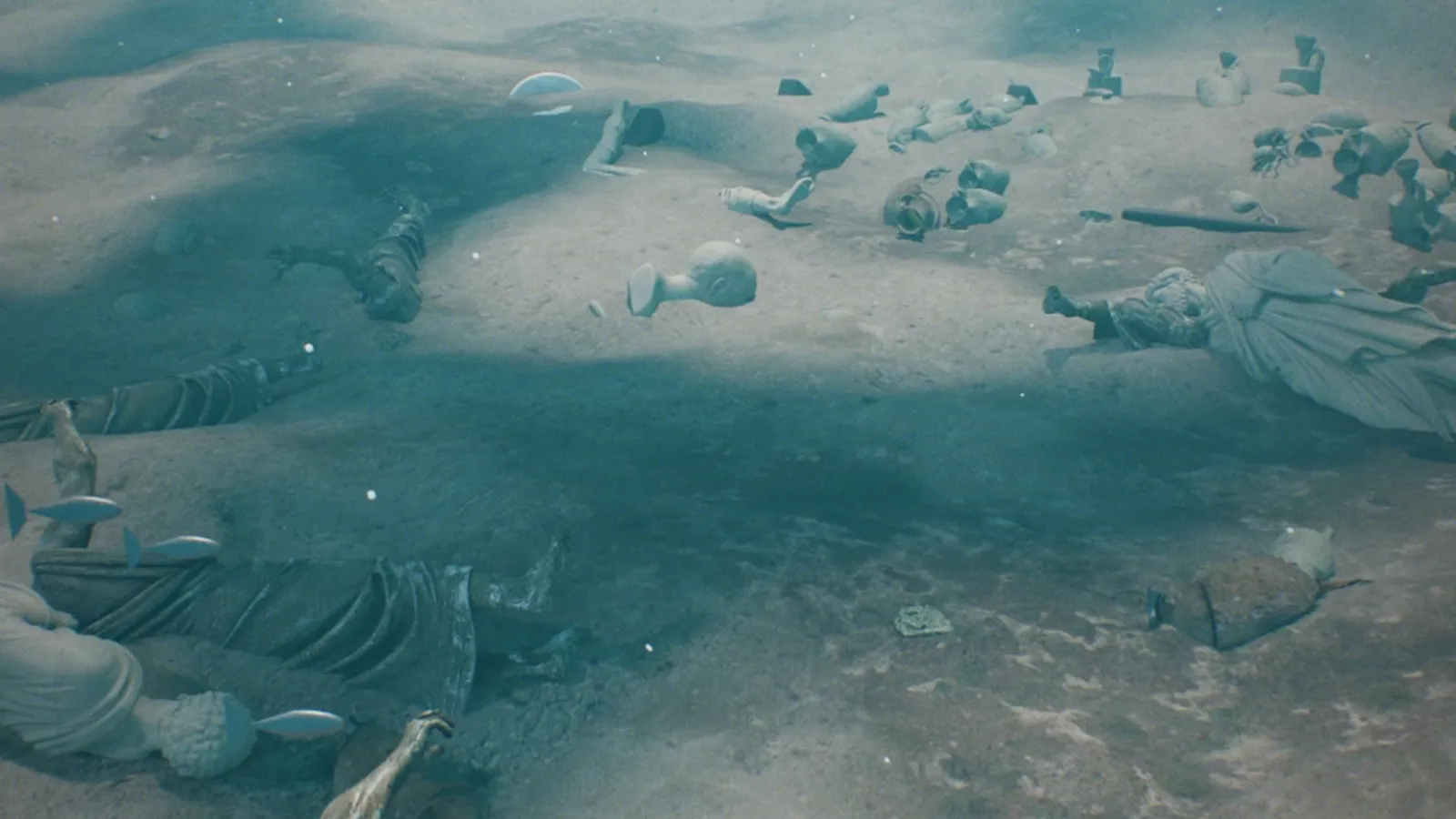
Off a Greek island, the seabed is covered in bodies.
Sponge divers found them, sheltering there from a storm.
But they’re not bodies. They’re statues, from a ship sunk 2,000 years ago.
Beside them lies a green lump of bronze. It goes into a museum crate, and nobody looks twice.
Months later, someone spots a gear in it. A gear, 2,000 years old.
Decades later, X-rays find 30 gears inside. Who could build that, back then?
Sharper scans see through the crust, to thousands of letters engraved in the bronze.
They hold a manual, for a machine. Turn its crank, and dials track the Sun and Moon.
Keep turning, and a dial warns when the Sun or Moon will go dark.
So it’s a computer, made of gears that work out the sky.
Thousands of letters, and not one says who built it.
What we flag in the script
- Only about a third of the machine survives. “Not one says who built it” is true of the text we have. A lost piece could have named the maker.
- Who spotted the gear is disputed. The credit goes to Valerios Stais or to his cousin Spyridon, and the sources give 17 or 20 May 1902. The script says “someone”.
- Thirty gears. The count comes from the X-ray images Price and Karakalos made in 1971. The CT scans of 2005 confirmed 30 gears out of an estimated 35.
- “Thousands” of letters. Freeth (2021) says thousands; a 2016 review of the inscriptions counts over 2,000, about 95% of them read.
- “Computer” is the popular word. Wikipedia calls it an analogue computer. Scholars usually say astronomical calculator.
- The eclipse dial. It covers 38 lunar and 27 solar eclipses, and its glyphs give each one’s type and time.
Gallery 05 · Room 2 · Reconstructions
Stills from the reel
Frames from the film: reconstructions and illustrations, not photographs of the objects. Tap or hover to look closer.
01 The gearMay 1902. Someone spots a gear in the lump: a gear, 2,000 years old. 02 The X-raysDecades later, X-rays find 30 gears inside. 03 The machineTurn its crank, and dials track the Sun and Moon. The model follows a modern reconstruction; the crank itself is lost.
Records
Sources used in the fact-check, and for this gallery
- Smithsonian Magazine, “Exploring the Titanic of the Ancient World”
- National Geographic, “The Dial of Destiny is real”
- Tony Freeth, “The Antikythera Mechanism”, World Archaeology
- Freeth et al. (2021), “A Model of the Cosmos in the ancient Greek Antikythera Mechanism”, Scientific Reports
- Freeth (2014), “Eclipse Prediction on the Ancient Greek Astronomical Calculating Machine Known as the Antikythera Mechanism”, PLOS ONE
- “The Forgotten Pioneer: Valerios Stais and his research in Kythera, Antikythera and Thessaly”, Bulletin of the History of Archaeology
- Current Epigraphy (2008), “Inscriptions on the Antikythera Mechanism (1)”
- Wikipedia, “Antikythera mechanism”
- Wikipedia, “Antikythera wreck”
Credits
- Scenes built and rendered in Blender by Then & Theory / Alterra Editions; two shots (the storm, the diver) animated from our frames with generated video (Kling, via Higgsfield). Everything on screen is a reconstruction, not footage.
- The lump: “Antikythera Mechanism Main Fragment (CT)” by Ashkan Pakzad, CC BY 4.0, the real fragment's CT mesh (joined, scaled, sample holder cropped, new materials).
- The machine: “The Antikythera Mechanism” by Thomas Weibel, CC BY 4.0 (new materials, re-timed animation, crank handle added).
- “Bearded Marble Head from Antikythera” and “Marine-Encrusted Amphora – Lefkada” by iedu360.eu, and “Greek Amphoras_Set 02” by cebraVFX, all CC BY 4.0 (scaled and cropped; sea crust added to the amphorae set). All on Sketchfab.
- The bronze statue, the helmet diver and the sponge boat are generated 3D models (Higgsfield, Tripo image-to-3D).
- Amphorae from Max Hay's Fantasy Asset Pack, and a lab table and 1970s terminal from KitBash3D AtomPunk, under commercial licences. Greek lettering modelled in Inter by Rasmus Andersson (SIL Open Font License 1.1).
- From Poly Haven, CC0: Marble Bust 01 and Horse Statue 01 (Rico Cilliers), Wooden Crate 02 (James Ray Cock, Jurita Burger), Vintage Oil Lamp (Monsta3D), Magnifying Glass 01 (Nazar Borodavka), Boulder 01, Rock 07 and Rock 09.
- Textures and skies from Poly Haven, CC0: Rust Coarse 01 (Dimitrios Savva, Rico Cilliers); Marble 01, Plastered Wall 04, Wood Planks Dirt and Coast Sand 01 (Rob Tuytel); Coast Land Rocks 01 (Rob Tuytel, Rico Cilliers); Dark Wooden Planks (Amal Kumar); Rock Face 03; Kloofendal Overcast (Greg Zaal), Belfast Sunset and Studio Small 09.
- Narration: ElevenLabs voice “George”. Score: generated with ACE-Step 1.5 (model under the MIT licence).