Some of it we know. Some of it is theory. We'll always tell you which.

Then & Theory: What happened,and howwe know

Short films about the past and the evidence behind them, from a dinosaur found in an old seafloor to a murder in the Alpine ice.

Back through time

  1. 48 BC

    Alexandria

    Jump to the evidence
  2. c. 3300 BC

    Ötztal Alps

    Jump to the evidence
  3. c. 50,000 years ago

    Across Eurasia

    Jump to the evidence
  4. At least 67,800 years ago

    Muna, Sulawesi

    Jump to the evidence

A generated reconstruction, not footage.

48 BC · Alexandria

The scroll that survived the fire

The legend

Caesar's fire destroyed the Library of Alexandria.

The better-supported reading

The flames reached book warehouses on the docks. The library, which most accounts place in the palace district, was spared, and then left to decay.

Gallery 03 · The scroll that survived the fire

Gallery 03 · Hands on

The record, year by year

Drag through four centuries, from the kings to the 270s AD. Each line is marked: known, argued or legend.

Under the kings

Argued The story goes that the kings seized books from ships arriving in the harbour and kept the originals. It comes from one source, Galen, writing centuries later, and historians doubt it.

Source: Galen, on the Ptolemies' book collecting

48 BC

Known Caesar's fire sweeps the harbour.

Legend The library burned with it.

Argued The better-supported reading: the flames reached book warehouses on the docks, and the library, which most accounts place in the palace district, was spared.

Source: Plutarch, Life of Caesar 49; Cassius Dio

30 BC

Known Egypt becomes a Roman province. There is no king paying copyists any more.

Argued Without new copies, the rolls on the shelves are not replaced as they wear out. That neglect did what the fire couldn't is the view of Bagnall and others, built partly on missing evidence.

Source: Britannica, “Alexandria: history” (30 BC); Roger S. Bagnall, “Alexandria: Library of Dreams”

The years between

Known In damp sea air, papyrus doesn't last forever. Moisture damages the sheets and the ink.

Source: npj Heritage Science (2022); AIC Conservation Wiki

270s AD

Known A Roman army wrecks the palace district.

Argued By then, the case goes, little was left to lose. Some historians give more weight to later destructions.

Source: Encyclopaedia Romana, on Ammianus Marcellinus; National Geographic, reporting Modrow

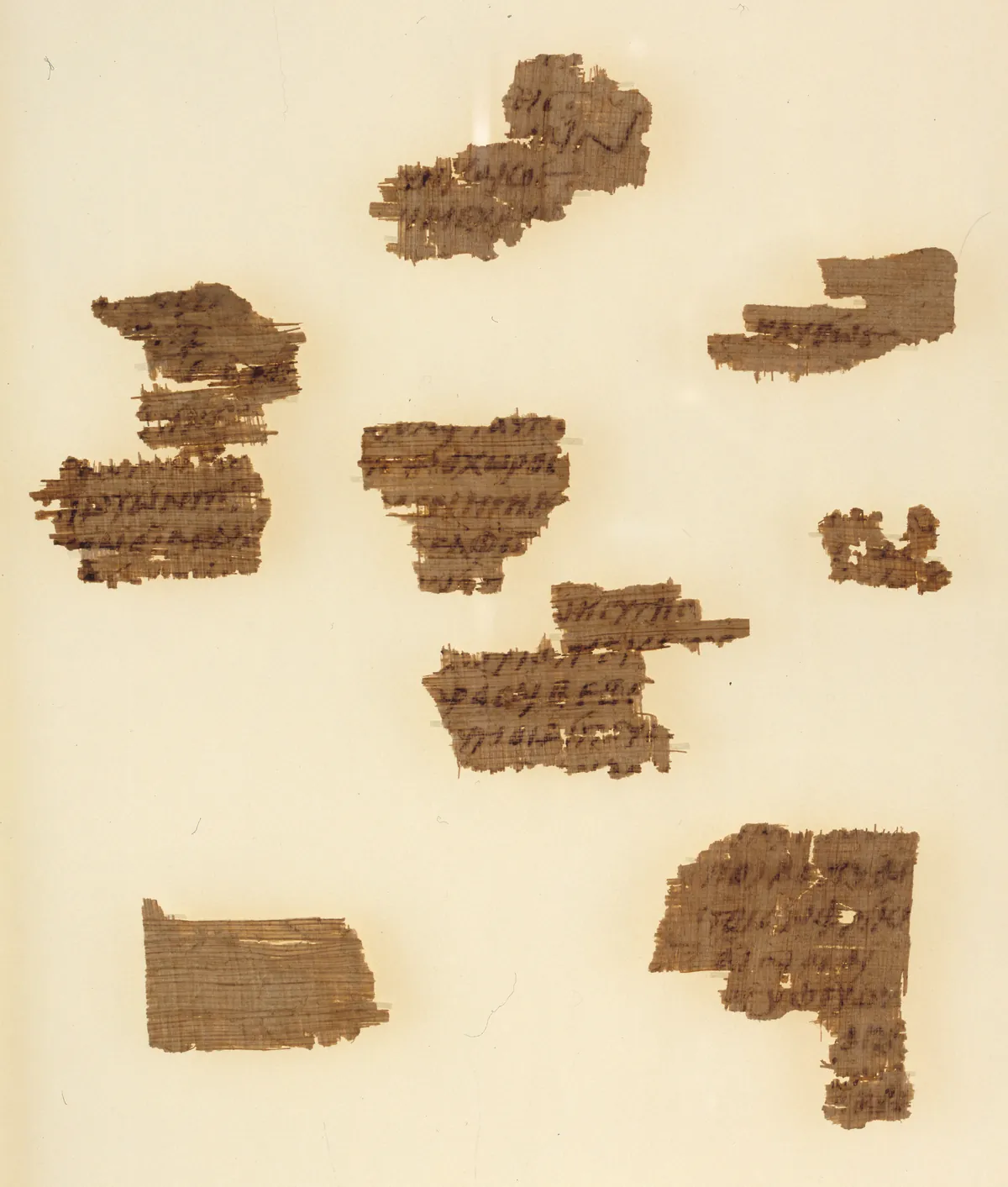
Nine torn fragments of papyrus on a pale mount, with lines of Greek written in dark ink: pieces of a copy of Sophocles' Oedipus the King.

Look closerThen use the arrow keys to move it.

What a surviving play looks like: fragments of Sophocles' Oedipus the King, copied around the 4th century AD and found at Oxyrhynchus in Egypt. Not from the library: a later copy of the kind of play our story follows.

Papyrus Oxyrhynchus 1369. Bridwell Library, SMU. Public domain, via Wikimedia Commons.

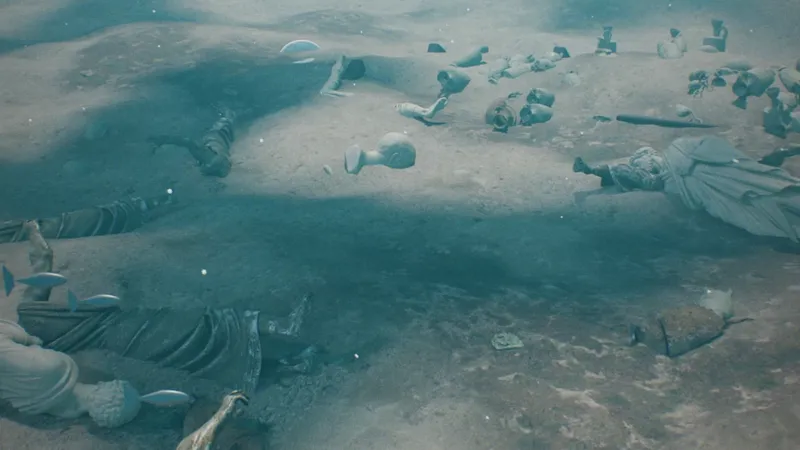
Through this door, the same century1st century BCAntikythera, Greece · Gallery 05In 1900, sponge divers sheltering from a storm off a Greek island found a wreck full of statues. Beside them lay a lump of bronze with gears inside.The lump that was a computer

c. 3300 BC · Ötztal Alps · Gallery 01

Who killed Ötzi?

  1. Two hikers, high in the Alps, spot something frozen in the ice.

  2. Police assume it's a climber who died recently. They're off by more than five thousand years.

  3. An X-ray shows something hidden in his shoulder.

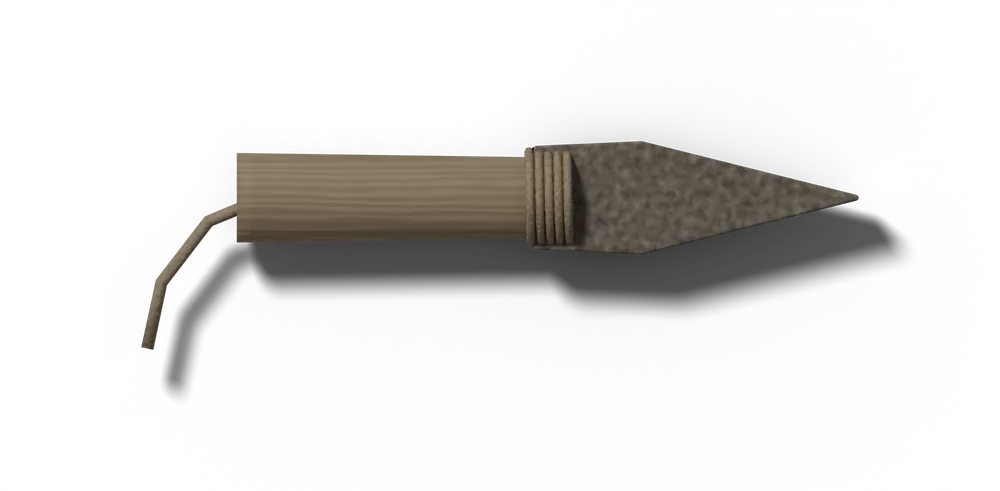
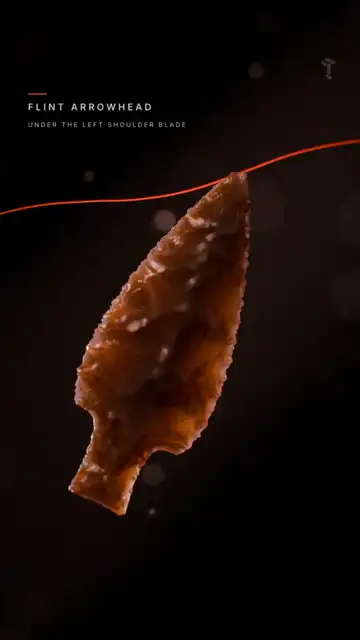
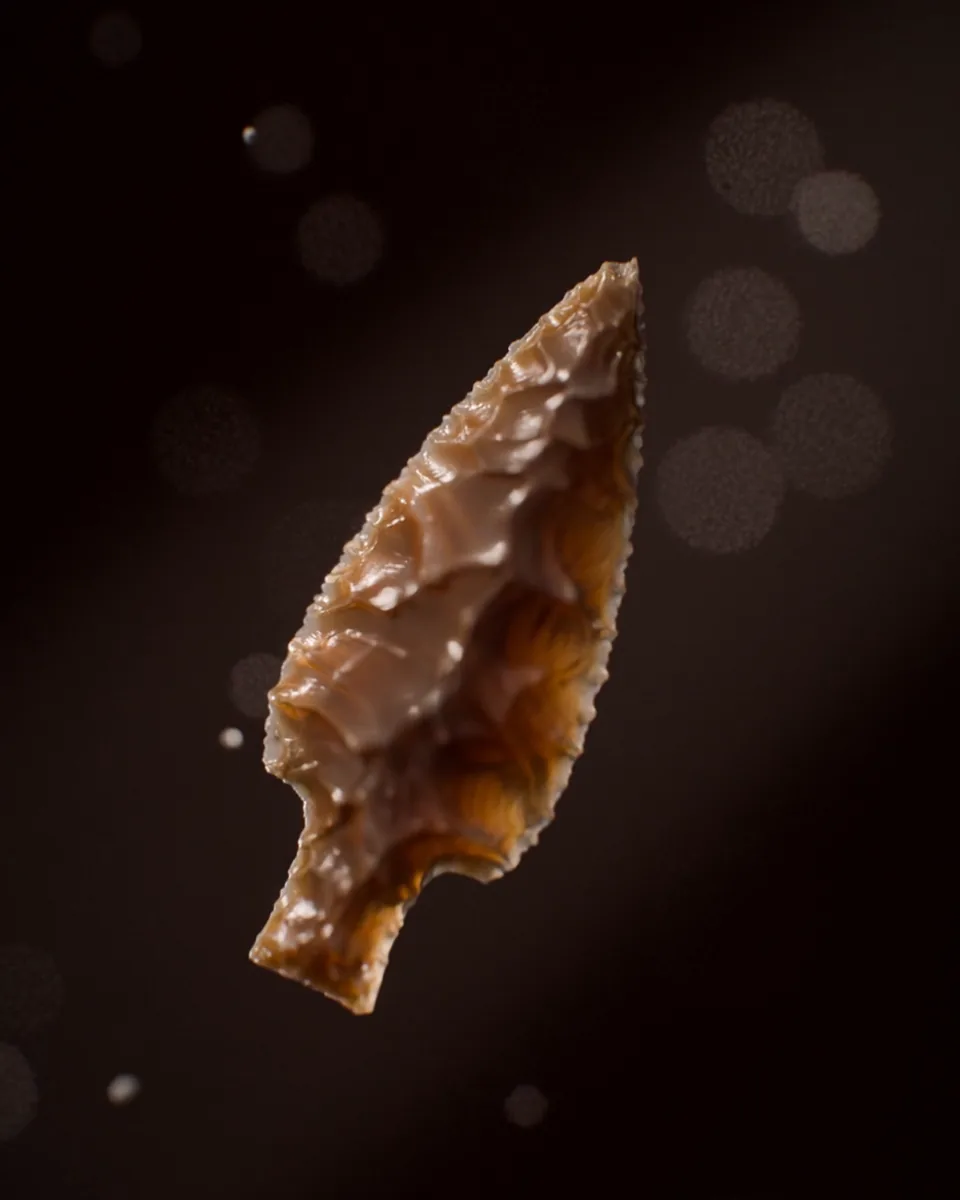
  4. A stone arrowhead. It had torn through an artery.

  5. His killer left a copper axe behind. We know how he died. Who did it may never be known.

Reconstruction of the flint arrowhead found in Ötzi's shoulder.Under the ice: 1 object
Rub the ice away
Watch the film

Gallery 01 · Hands on

What he carried

His kit survived with him in the ice. Here it lies in one drawer, every piece to the same scale. Choose one to read its label.

Scale: the drawer is 2 metres wide. Ötzi stood about 1.60 metres tall; the bow is longer than he was tall.

Reconstruction of the copper axe, seen from above.

01 · Haft about 60 cm

Copper axe

A trapezoid blade of 99.7% pure copper, cast in a mould and hammered, set in a forked yew haft with birch tar and bound with leather straps.

Known The only axe of its kind preserved intact. The copper came from ore mined in southern Tuscany, not the Alps. Wear shows it was used often and resharpened.

Argued Why his killer left such a valuable thing behind is still a mystery. Our case reads it as a sign this wasn't a robbery.

Reconstruction of the yew bow, unfinished, seen from above.

02 · 1.82 m

Yew bow, unfinished

A yew stave he was shaping into a new bow with his axe. It still needed rubbing down, polishing and a string.

Known Experiments with a model of the bow show it can kill from 30 to 50 metres away.

Argued Why he needed a new bow is unclear. His old one may have broken or been stolen.

Reconstruction of the quiver and arrows, seen from above.

03 · Length not given

Quiver and arrows

Deer hide, stiffened with a hazel rod. Inside: 12 unfinished arrow shafts and 2 finished arrows of wayfaring tree and dogwood, four antler tips and a 2 m bowstring.

Known The two finished arrows have flint heads, bound on with plant fibres; the fletching is fixed with birch tar. The arrow that killed him came from behind; its flint head was found in his shoulder.

See his real flint, drawn Rub the ice off the arrowhead
Reconstruction of the flint dagger, seen from above.

04 · 13 cm

Flint dagger

A flint blade forced into an ash handle and bound with animal sinew, in a sheath of lime bast.

Known The only fully preserved dagger from the Copper Age. Its flint came from Trentino. The blade is hardly bigger than an arrowhead, perhaps from being resharpened so often.

See his real flint, drawn
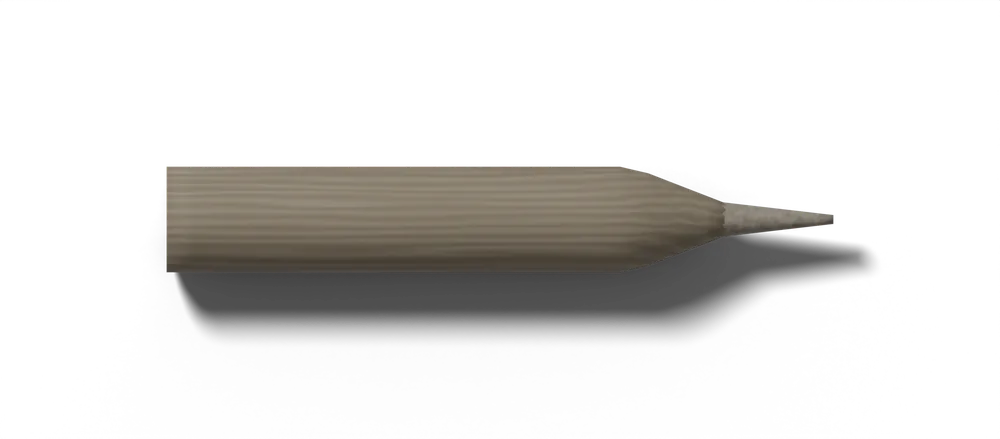
Reconstruction of the retoucheur, seen from above.

05 · 12 cm

Retoucheur

A stripped lime branch sharpened like a pencil, with a piece of antler hammered into its core as the point.

Known He used it to shape and resharpen flint blades. The tool was unknown before he was found.
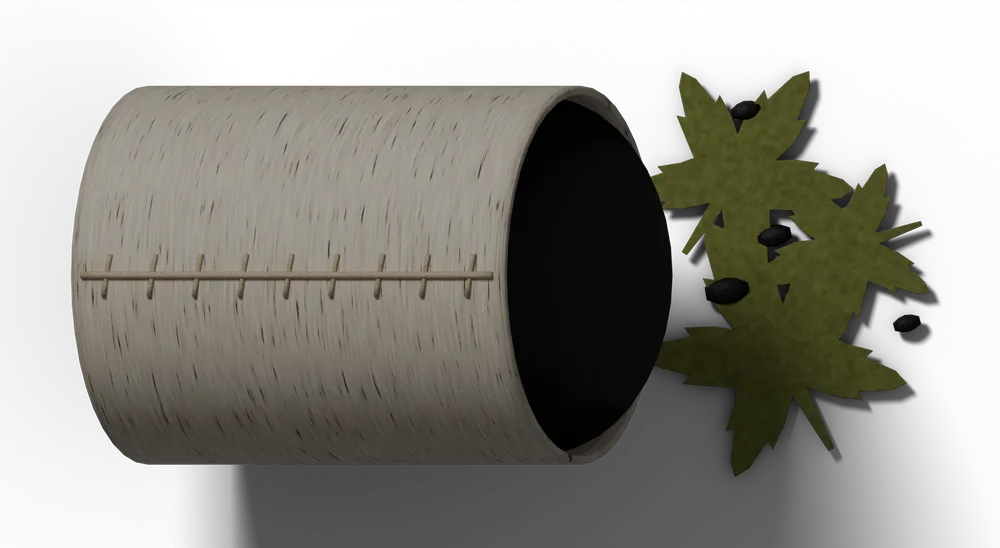
Reconstruction of the ember carrier, seen from above.

06 · About 20 cm high

Ember carrier

One of two birch-bark pots, each made from a single piece of bark and stitched with lime bast.

Known Its inside was blackened, and it held freshly picked Norway maple leaves and pieces of charcoal.

Argued It is assumed he wrapped embers in the leaves and carried them in it, keeping fire for hours.
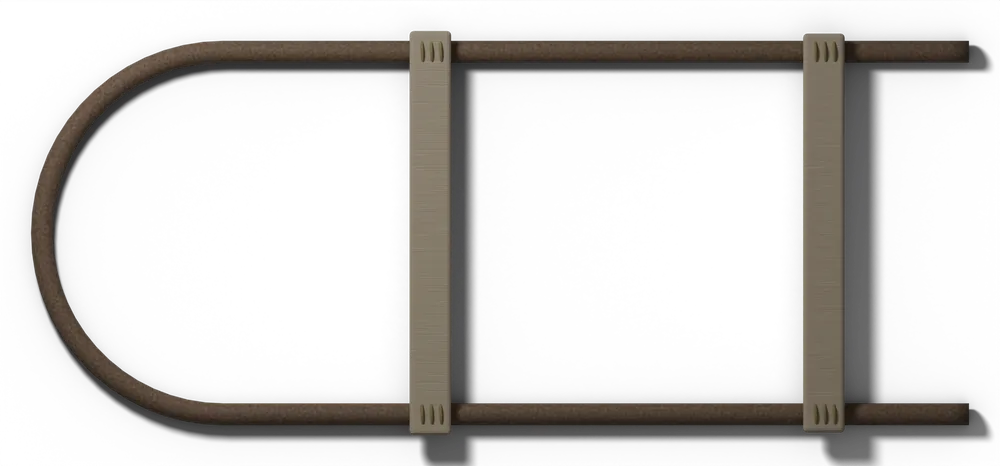
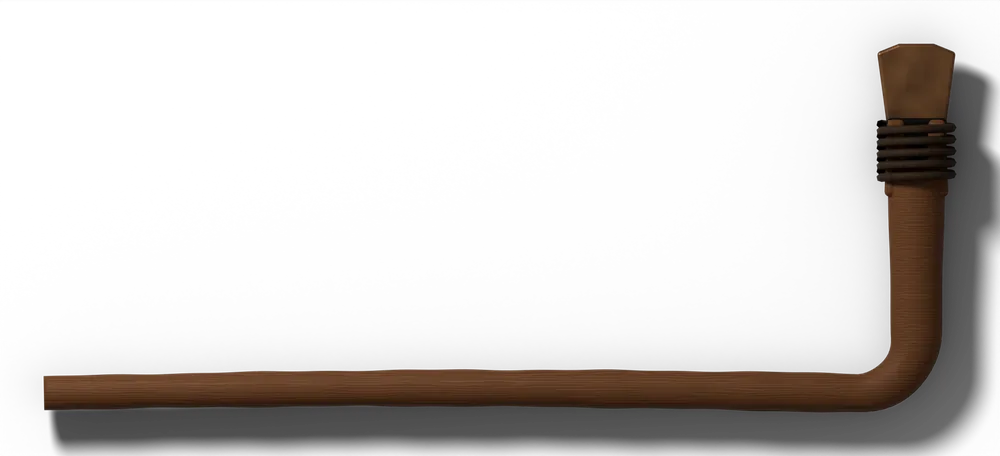
Reconstruction of the backpack frame, seen from above.

07 · Rod about 2 m

Backpack frame

A U-shaped hazel rod and two narrow wooden boards, 38 to 40 cm long: the only parts that survive.

Known Wooden backpacks have a long tradition in the Alps.

Argued The frame probably carried a hide sack or a net, tied on with string.
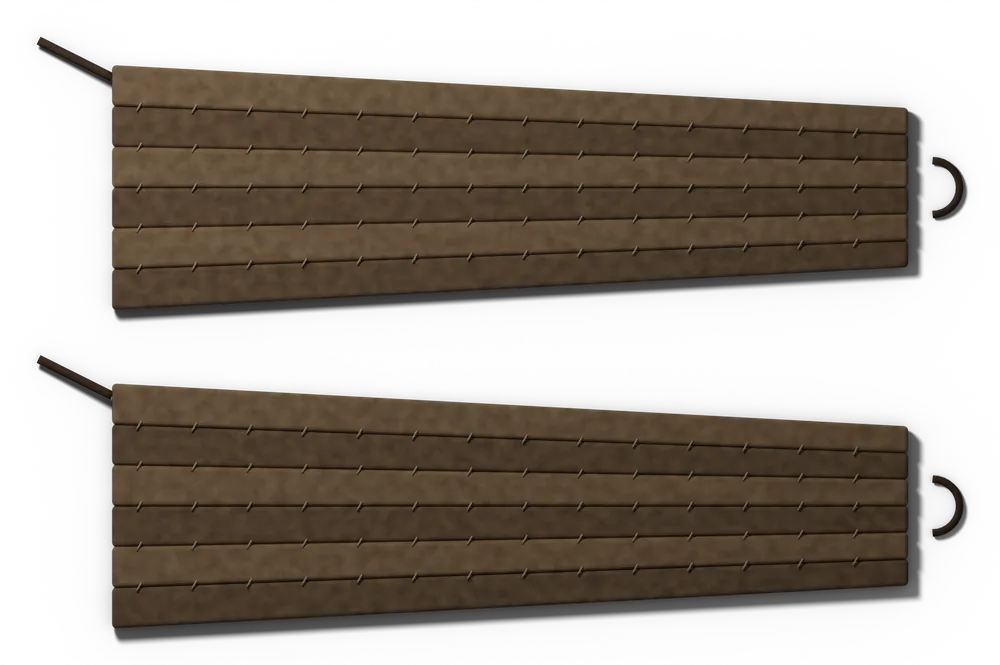
Reconstruction of the clothing, seen from above.

08 · Leggings about 65 cm

Clothing

Leather, hide and braided grass only, stitched with sinew, grass and bast: a goat- and sheep-hide coat worn fur out, goat-hide leggings, a loincloth, a calfskin belt, deerskin shoes padded with grass, and a bearskin cap.

Known No wool or woven cloth was found. Seams in the coat had been mended with grass, probably by him.

Argued A woven grass mat found with him was first read as a cape. It is now thought more likely a mat against rain, or part of the backpack.

Reconstructions by Then & Theory, modelled from the museum's descriptions and sizes; the quiver is drawn without a size, because the museum gives none. His height: about 1.60 m (the museum, on the mummy (opens in a new tab)). Facts: the South Tyrol Museum of Archaeology, which keeps Ötzi and his kit, on his equipment (opens in a new tab) and clothing (opens in a new tab).

In the cabinet · The real flint

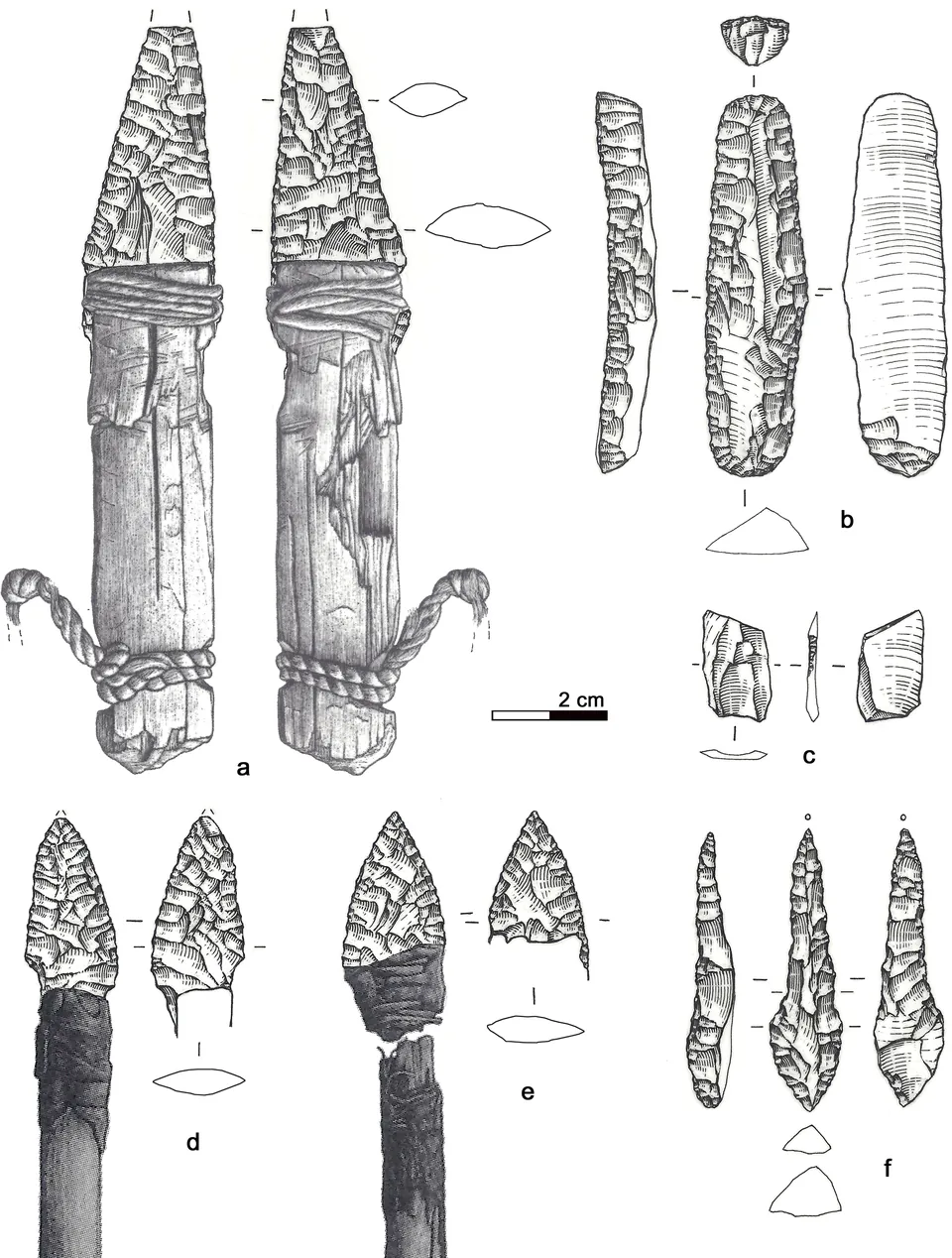
The drawer holds our reconstructions. These are his actual stone tools, drawn by the archaeologists who studied them in 2018. Choose a number, or look closer.

An archaeological drawing, in fine pen hatching, of a flint dagger in its wooden handle seen from both sides, a long endscraper, a small flake, two leaf-shaped arrowheads (one still on its broken shaft) and a slender borer, with a 2 cm scale bar.

An archaeological drawing, in fine pen hatching, of a flint dagger in its wooden handle seen from both sides, a long endscraper, a small flake, two leaf-shaped arrowheads (one still on its broken shaft) and a slender borer, with a 2 cm scale bar.

The real objects, drawn

His flint tools

Object
Flint dagger, endscraper, borer, flake and two arrowheads found with Ötzi
Date
About 3300 BC; drawn for publication in 2018
Place
Tisenjoch, Ötztal Alps; now in the South Tyrol Museum of Archaeology, Bolzano
Material
Chert (flint), ash wood, sinew, birch-bark tar
Collection
South Tyrol Museum of Archaeology. Drawing: Wierer et al. 2018, fig. 1

The stone half of his kit, drawn from the originals, each tool from front and back. Most were worn out: used, resharpened and broken. He seems not to have had fresh flint for some time.

  1. A broken tip

    An old fracture at the tip of the dagger, where a fossil in the stone had weakened it. It may have broken in use. Source: Wierer et al. 2018.

  2. Sinew, no glue

    The 69 mm blade sits in a deep slit in the ash handle, held with sinew and no tar. A string of lime-tree fibre helped pull it from its sheath. Source: Wierer et al. 2018.

  3. A trace of copper

    Copper traces sit in two scratches on the blade, perhaps from touching his axe. It isn't clear whether they are ancient or from the recovery. Source: Wierer et al. 2018.

  4. Worn to the end

    The 66.5 mm endscraper, from his belt pouch. Most of the tools had reached the end of their use: much used, resharpened and broken. Source: Wierer et al. 2018.

  5. 46 mm of flint

    The arrowhead of arrow 12, set in a split in the shaft, tied with plant thread and covered in birch-bark tar. Source: Wierer et al. 2018.

Drawing: Wierer, Arrighi, Bertola, Kaufmann, Baumgarten, Pedrotti, Pernter and Pelegrin, PLOS ONE · CC BY 4.0

Notes from Wierer et al., “The Iceman's lithic toolkit”, PLOS ONE 13 (2018).

The Earth today. Imagery: NASA Blue Marble

c. 50,000 years ago · Across Eurasia · Gallery 02

We weren't the only humans

How tall they stood

To scale. The H. sapiens figure is a reference height of 1.70 m. Dashed figures have no bones yet that give a height, so they stand at that height too. Choose a figure to read about it.

Portraits are generated reconstructions based on published fossil evidence; see sources

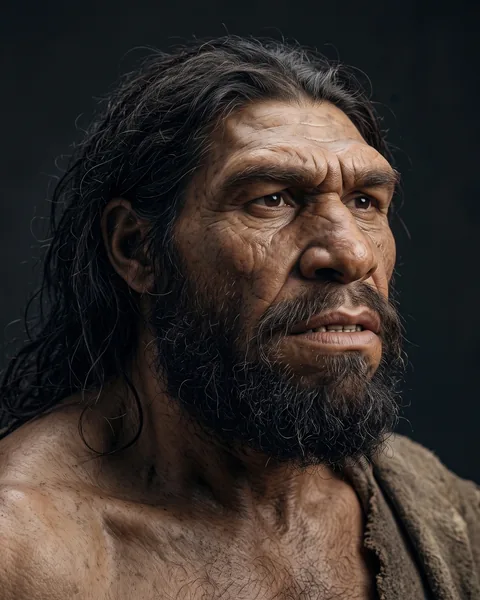
  1. Neanderthals

    Europe and western Asia.

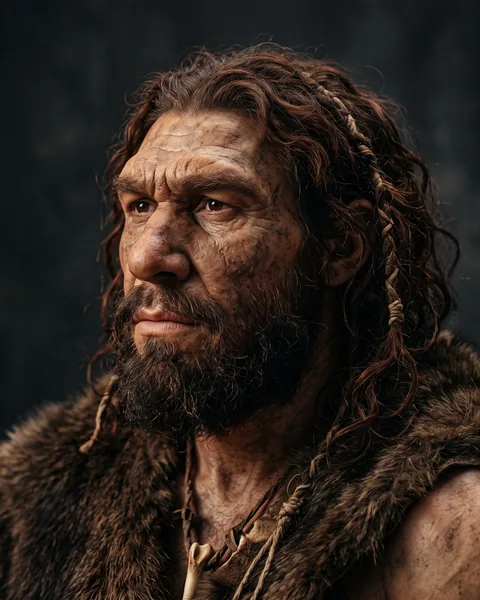
    Generated reconstruction of a Neanderthal.Reconstruction
    Generated reconstruction, based on published skulls and skeletons.
    When
    About 400,000 to 40,000 years ago
    Where
    Europe and southwestern to central Asia
    Height
    About 1.64 m for men and 1.55 m for women, on average
    Brain size
    About 1,200 to 1,750 cm³
    First found
    Engis, Belgium, in 1829; recognised after the Neander Valley find of 1856
    Key evidence
    Thousands of fossils from hundreds of people, and several full genomes
    Traces in people today
    About 1 to 4% of the DNA of present-day Europeans and Asians

    What we knowThey were shorter and stockier than us, built for the cold, with brains as large as ours or larger. They made tools and clothing, controlled fire and buried some of their dead.

    Still arguedWhy they died out by about 40,000 years ago: a changing climate, competition with modern humans arriving in Europe, or both.

    Sources: Smithsonian (opens in a new tab) · Natural History Museum (opens in a new tab) · Australian Museum (opens in a new tab)

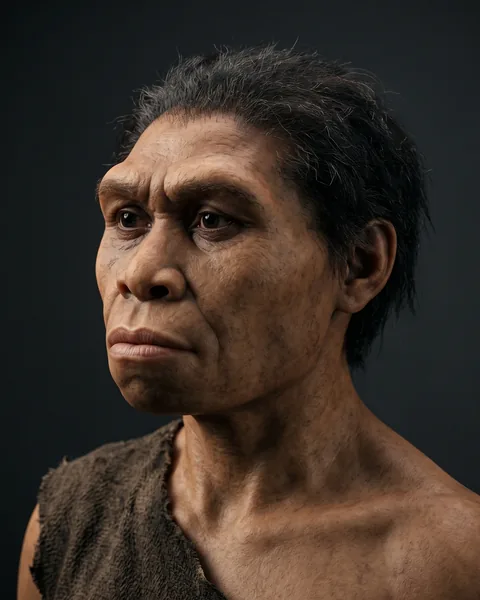
  2. Denisovans

    Farther east, known mostly through DNA and a small fossil record.

    Generated reconstruction of a Denisovan, based on the Harbin skull.Theory
    Generated reconstruction based on the Harbin skull, which 2025 studies tie to the Denisovans.
    When
    About 500,000 to 30,000 years ago, estimated from few fossils and DNA
    Where
    Siberia, the Tibetan Plateau and, if the Harbin skull is theirs, northeast China
    Height
    Unknown
    Brain size
    Unknown
    First found
    Denisova Cave, Siberia, in 2008: a girl's finger bone
    Key evidence
    A finger bone, teeth and a skull fragment from Denisova Cave, a jaw from Tibet, and the Harbin skull
    Traces in people today
    About 3 to 5% of the DNA of Melanesians and Aboriginal Australians

    What we knowMost of what we know comes from DNA: the finger bone's genome, published in 2010, showed a kind of human no one had seen before. They interbred with Neanderthals and with our own ancestors.

    Still arguedWhat they looked like. In 2025 proteins and mitochondrial DNA tied the Harbin skull from northeast China, named Homo longi in 2021, to Denisovans. It is one skull, so how well it stands for the whole group is still open.

    Sources: Australian Museum (opens in a new tab) · Science (2025) (opens in a new tab) · Cell (2025) (opens in a new tab)

  3. Homo floresiensis

    A tiny-bodied human on the island of Flores.

    Generated reconstruction of Homo floresiensis.Reconstruction
    Generated reconstruction, based on the LB1 skull and skeleton.
    When
    Fossils about 100,000 to 60,000 years ago; its stone tools until about 50,000
    Where
    Flores, Indonesia
    Height
    About 1.06 m, estimated from one woman's skeleton
    Brain size
    About 420 cm³, a third the size of ours
    First found
    Liang Bua cave, Flores, in 2003
    Key evidence
    LB1, a nearly complete skeleton, and bones and teeth from up to 12 individuals
    Traces in people today
    None known. No DNA has been recovered from its bones

    What we knowThey made stone tools and hunted Stegodon, a small elephant. Fossils about 700,000 years old from elsewhere on Flores suggest the species or its ancestor was on the island long before.

    Still arguedWhere it came from: Homo erectus that shrank over time on the island, or an older, smaller kind of human that was already small when it arrived.

    Sources: Smithsonian (opens in a new tab) · Natural History Museum (opens in a new tab) · Australian Museum (opens in a new tab)

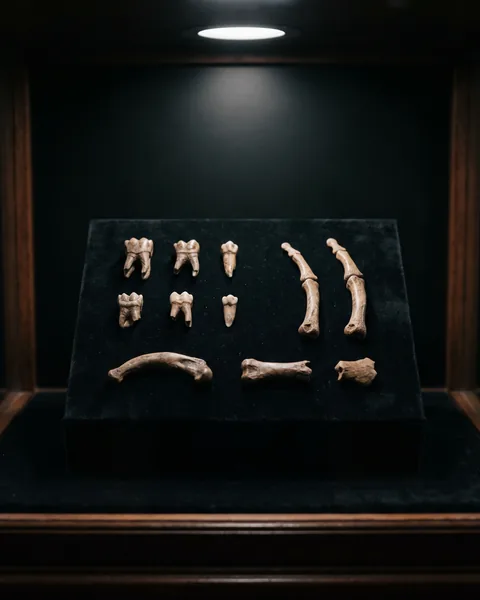
  4. Homo luzonensis

    Luzon, with remains roughly 50,000 to 67,000 years old.

    Generated still life of small teeth and finger and toe bones, like those found in Callao Cave.Fossils only
    A still life of the kinds of remains found: teeth, finger and toe bones. Generated, not a photograph of the fossils.
    When
    At least 50,000 to 67,000 years ago, by the dates published with the species
    Where
    Callao Cave, Luzon, the Philippines
    Height
    Unknown
    Brain size
    Unknown: no skull has been found
    First found
    Callao Cave, in 2007: a foot bone. Named as a species in 2019
    Key evidence
    13 fossils from at least three individuals: teeth, finger and toe bones, and a child's thigh bone
    Traces in people today
    None known. No DNA has been recovered

    What we knowIts teeth are small and look much like ours. Its finger and toe bones are curved like those of australopithecines, which suggests it may have climbed.

    Still arguedNo skull or face has been found, so any face drawn for it is invented. Its age is open too: a 2023 re-dating by Grün and Stringer suggests the fossils could be at least 130,000 years old.

    Sources: Natural History Museum (opens in a new tab) · Nature (2019) (opens in a new tab) · Journal of Human Evolution (2022) (opens in a new tab) · Quaternary Science Reviews (2023) (opens in a new tab)

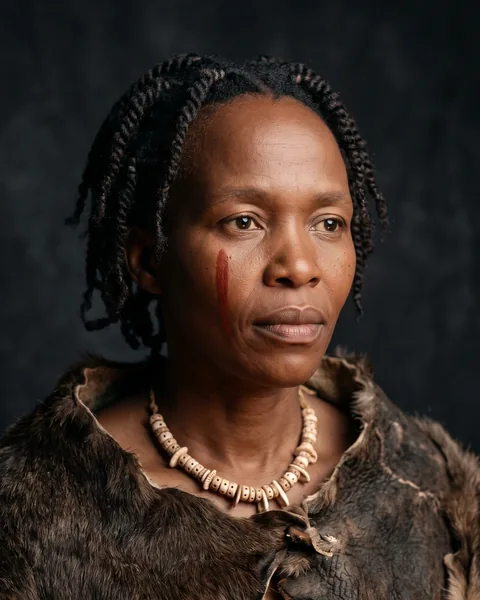
  5. Homo sapiens

    Our own species. It interbred with Neanderthals, and people alive today still carry traces of that ancestry.

    Generated portrait of a Homo sapiens from the Ice Age.Reconstruction
    Generated portrait of an Ice Age Homo sapiens.
    When
    About 300,000 years ago to today
    Where
    Evolved in Africa; now worldwide
    Height
    Varies from population to population. The chart uses 1.70 m as a reference height
    Brain size
    About 1,300 cm³ on average
    First found
    No type specimen: Linnaeus named the species in 1758
    Key evidence
    Fossils across Africa and Eurasia, such as Skhūl V from Israel
    Traces in people today
    Every person alive today

    What we knowBy 164,000 years ago people were collecting and cooking shellfish, and by 90,000 years ago they were making fishing tools. Our ancestors interbred with both Neanderthals and Denisovans.

    Still arguedWho our direct ancestor was, Homo heidelbergensis or another species, and how much our ancestors interbred with Neanderthals.

    Sources: Smithsonian (opens in a new tab) · Australian Museum (opens in a new tab)

Watch the film

Loading the scan…

They shared it with mammoths

A woolly mammoth skeleton from the Smithsonian's collections, scanned in 3D. Drag to turn it.

3D scan: Smithsonian National Museum of Natural History, Open Access

Bones from the Ice Age

In the cabinet · The Ice Age

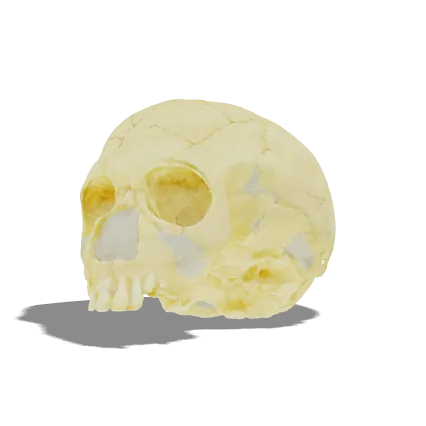
Bones from the time when other kinds of human shared the world with us: a Neanderthal child from Central Asia, and a mammoth's tooth from a Swiss gravel pit.

A cast of a child's skull, cream with brown patches, with a rounded braincase, large eye sockets and a row of upper teeth; faint lines show where it was pieced together.

Museum cast, scanned in 3D

The Neanderthal child of Teshik-Tash

Object
Cast of the skull of Teshik-Tash 1, a Neanderthal child
Date
About 70,000 years old (Smithsonian Human Origins)
Place
Teshik-Tash Cave, Bajsuntau mountains, Uzbekistan; found in 1938
Material
Resin replica, about 19.5 × 13.5 × 10.5 cm
Collection
Museu de la Universitat de València d'Història Natural, MGUV 36476

Neanderthals didn't only live in Europe. This child, about 8 to 11 years old, was found in 1938 in a cave in Uzbekistan, in Central Asia.

  1. A Neanderthal, twice over

    Studies of the shape of the skull and of the child's mitochondrial DNA both place it among the Neanderthals. Source: American School of Prehistoric Research (Harvard), on Okladnikov's excavation of 1938–39.

  2. A child

    The skull is a child's, about 8 to 11 years old. Source: Smithsonian Human Origins, “Teshik-Tash”.

  3. Horns round the grave

    The excavators found the child in a shallow pit with at least five pairs of Siberian ibex horns arranged round the body. The arrangement has long been read as deliberate, perhaps ritual. Source: American School of Prehistoric Research (Harvard), on Okladnikov's excavation of 1938–39.

3D model: Museo [UV] Historia Natural (Andreu Vilaplana) · CC BY 4.0

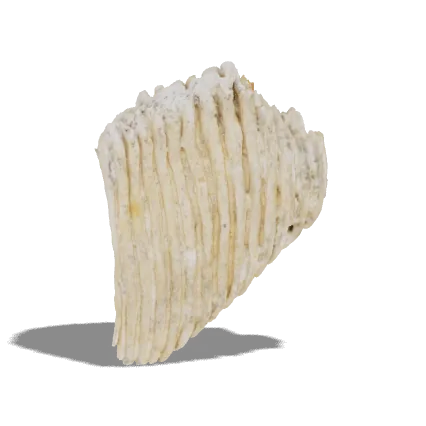
A large fossil molar, pale and chalky, its side ribbed with a row of thin, upright enamel plates like the pages of a closed book.

Fossil, scanned in 3D

A mammoth's molar

Object
Upper right third molar (M3) of a mammoth
Date
At least 29,000 years old (a preliminary radiocarbon date)
Place
Gravel pit at Cham-Oberwil, Canton Zug, Switzerland; found in 2018
Material
Fossil tooth
Collection
Amt für Denkmalpflege und Archäologie, Kanton Zug

A mammoth's upper molar, at least 29,000 years old, which turned up in a Swiss gravel pit in 2018.

  1. Plates of enamel

    Over about 3 million years, mammoth molars grew taller, gained more of these plates and thinner enamel: probably an adaptation to a diet more and more of grass. Source: Ferretti, “Structure and evolution of mammoth molar enamel”, Acta Palaeontologica Polonica 48 (2003).

  2. Before the ice's peak

    A preliminary radiocarbon date gives at least 29,000 years: from before the coldest point of the last glaciation. Source: Amt für Denkmalpflege und Archäologie, Kanton Zug, on Sketchfab (after Tugium 35, 2019).

  3. Found by a digger

    The tooth came out of a working gravel pit and was slightly damaged by the excavator, before or as it was lifted. Source: Amt für Denkmalpflege und Archäologie, Kanton Zug, on Sketchfab (after Tugium 35, 2019).

3D model: Amt für Denkmalpflege und Archäologie, Kanton Zug, Jochen Reinhard · CC BY 4.0

At least 67,800 years ago · Sulawesi

Hands on the wall

Reconstruction: horses painted on a cave wall, lit by a hearth. From a Then & Theory film.

Hands on

Leave your hand on the rock

Press and hold on the wall. Pigment around a hand pressed to the rock leaves its outline: a hand stencil, one of the oldest kinds of picture people made.

Further back

In the cabinet · Before 300,000 years ago

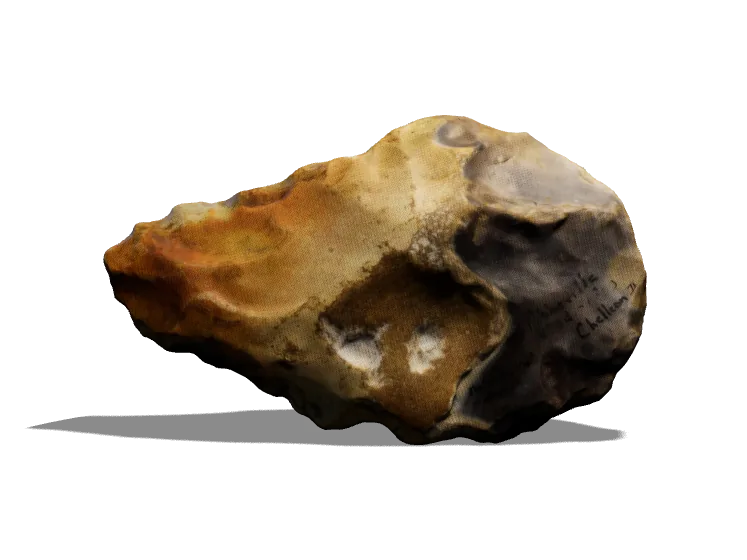
Older than any painting on any wall: a flint tool shaped by earlier humans in what is now northern France.

A flint tool the size of a hand, mottled orange-brown and dark grey, roughly almond-shaped and pointed at one end, covered in the shallow scars of flakes knocked off both faces.

Stone tool, scanned in 3D

A flint hand axe from the Somme

Object
Acheulean hand axe
Date
Lower Palaeolithic, before 300,000 years ago
Place
Abbeville, Somme valley, France
Material
Flint, 16.7 × 10.1 × 4.2 cm
Collection
North Carolina Archaeological Collection, Research Laboratories of Archaeology, UNC Chapel Hill, 518a2

Long before anyone painted a cave, earlier humans shaped flint like this, flaking both faces into a pointed, almond-shaped tool. Hand axes were made for well over a million years.

  1. Two faces

    A hand axe began as a large flake of stone, shaped by striking smaller flakes from around its edges. The scars of those blows cover both faces of this one. Source: Smithsonian Human Origins, “Early Stone Age tools”.

  2. When they were made

    Early humans were making hand axes by about 1.76 million years ago. The toolkit they belong to, the Acheulean, went on until about 400,000 to 250,000 years ago, ending at different times in different places. Source: Smithsonian Human Origins, “Early Stone Age tools”.

  3. Abbeville

    In the 1830s Boucher de Perthes began collecting flints round Abbeville and came to believe they were tools made by prehistoric people. He published his case in 1847; almost no one accepted it until 1859. Source: Linda Hall Library, “Blade and bone”: Abbeville flints, 1847.

3D model: Kathleen Brock, Research Laboratories of Archaeology, UNC · CC0 1.0

What the name means

Then

What happened. The glacier, the fire, the flood; the animal that walked here and the person who made the tool.

Theory

How we know. The X-ray, the arrowhead, the bone in the rock, and the reasoning that joins them. Where the record runs out, we say so.

Every story starts with something you can point to.

The four rules we make a case by are at the information desk, and in How we know you can date a sample yourself.

The plates, printed to wear

Each garment carries a plate from the archive. Editions are made to order and shipped by our fulfilment partner, Fourthwall.

See all 50

Floor planMenu · You are in Today

Admit oneThen & Theory

Each hall you visit is stamped here.

Kept in this browser only.

Your cart

Your cart is empty.

Every edition is printed after you order it, so nothing here is held for you. Start with one of these.

Browse the catalogueHelp me choose Make your own
Subtotal—

Shipping and any taxes are shown at checkout, before you pay.

You pay on Fourthwall's secure checkout. Fourthwall is our store and fulfilment partner; we never see your card details.