c. 50,000 years ago
Across Eurasia
Gallery 02 · We weren't the only humans
Gallery 02 · The Ice Age
We weren't the only humans
In the Ice Age, Homo sapiens shared the world with at least four other human lineages.
- Subject
- Human origins
- Era
- Ice Age
- Place
- Across Eurasia
- Format
- Reel · 64 s
Gallery 02 · Room 1
The film
The script
The strangest thing about the Ice Age wasn’t the mammoths. It was that we weren’t the only humans.
Across Europe and Western Asia lived Neanderthals. Farther east were Denisovans, a human lineage known mostly through DNA and a small fossil record. And they weren’t alone.
On Flores lived Homo floresiensis, a tiny-bodied human. On Luzon, Homo luzonensis left remains dating back roughly 50,000 to 67,000 years.
These groups did not all share one place, but their histories overlapped. And when some met, the boundary between them wasn’t absolute.
One bone from Denisova Cave belonged to a girl with a Neanderthal mother and a Denisovan father. Homo sapiens also interbred with Neanderthals, including around 45,000 to 49,000 years ago.
Then the other human lineages disappeared as distinct populations, but not completely. Traces of Neanderthal and, in some populations, Denisovan ancestry are still carried by people alive today.
We’re the last surviving human species. But human history was never ours alone.
Gallery 02 · Room 2 · In the case
Bones from the Ice Age
Casts of three skulls, published as 3D scans by the University of Liège: a Neanderthal, the woman from Flores, and one of the first fossils recognised as our own species. The Neanderthal is here twice: as a cast, and in stereo photographs from 1911, each view taken twice a little apart. Rock between the two frames to see it turn. Then a tooth from the same Ice Age, from a sabre-toothed cat in California.
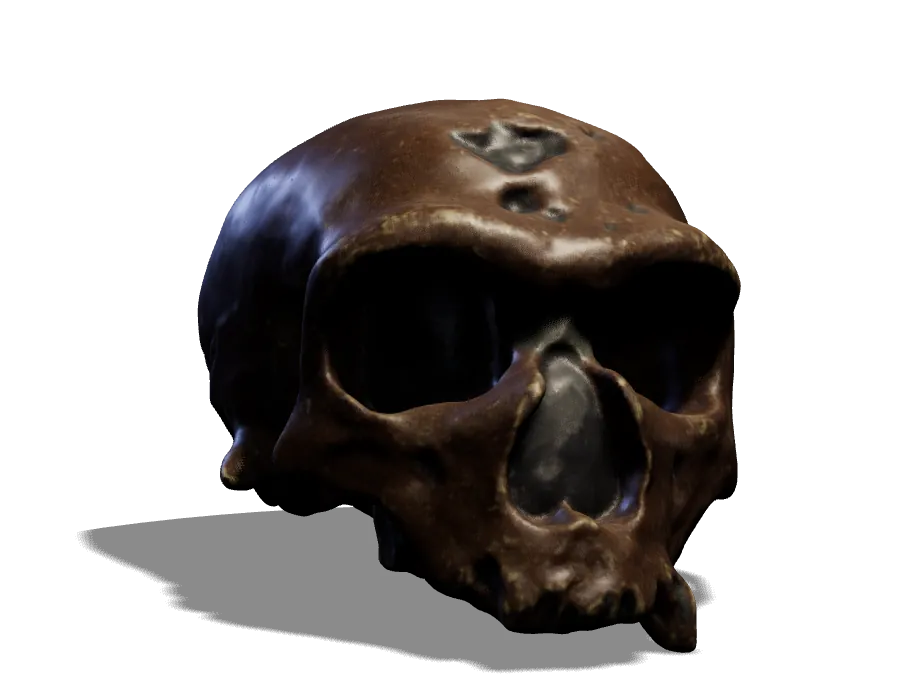
A brown cast of a heavy skull without its lower jaw: long and low, with a thick brow ridge over large eye sockets, a big nasal opening and few upper teeth.
Neanderthal · cast, scanned in 3D
La Chapelle-aux-Saints 1
- Object
- Cast of the skull of a Neanderthal man, without the jaw
- Date
- About 60,000 years old; found 1908
- Place
- La Chapelle-aux-Saints, France
- Material
- Cast of fossil bone
- Collection
- Service de biologie du comportement, University of Liège
The old man of La Chapelle: the first fairly complete Neanderthal skeleton anyone had found. The skull is long and low, with a heavy brow and a face that juts forward.
Brow and forehead
The low, receding forehead, protruding midface and heavy browridges typical of Neanderthals. Source: Smithsonian Human Origins, “La Chapelle-aux-Saints”.
Missing teeth
He had lost many teeth, some perhaps decades before he died: bone had grown back along the gums. He may have needed his food ground down, and others may have looked after him. Source: Smithsonian Human Origins, “La Chapelle-aux-Saints”.
3D scan: Service de biologie du comportement, University of Liège (ULiège), via Sketchfab · CC BY 4.0
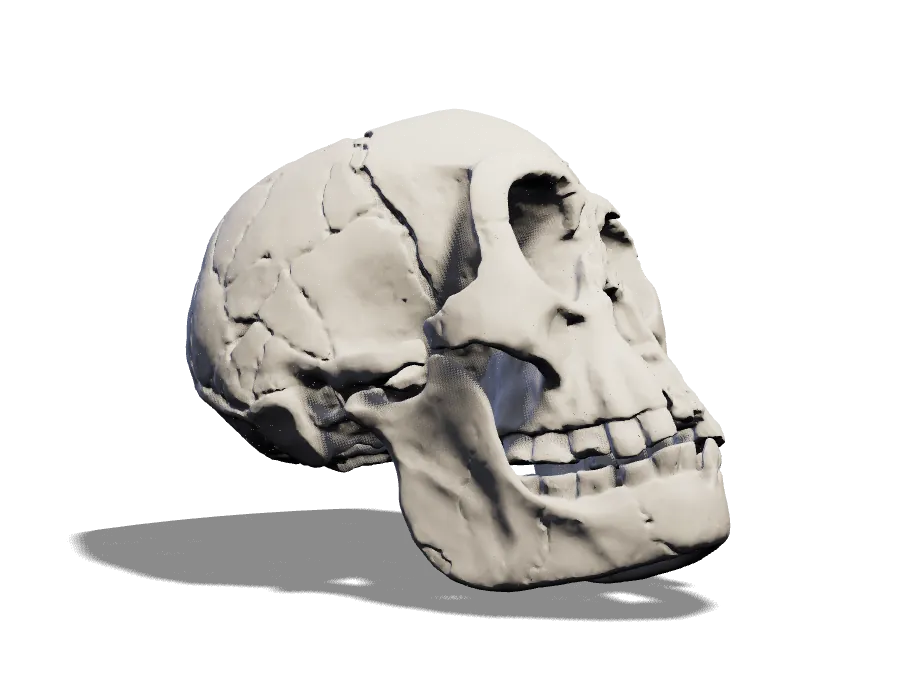
A white cast of a very small skull with its lower jaw: a small, low braincase, a brow ridge, and large teeth for its size.
Homo floresiensis · cast, scanned in 3D
LB1, Homo floresiensis
- Object
- Cast of the skull and jaw of an adult woman
- Date
- The species' fossils are about 100,000 to 60,000 years old; found 2003
- Place
- Liang Bua cave, Flores, Indonesia
- Material
- Cast of fossil bone
- Collection
- Service de biologie du comportement, University of Liège
The woman from Flores stood a little over a metre tall and died at about 30. LB1 is the most complete fossil of her species.
A small brain
Her brain is estimated at about 400 cubic centimetres, as small as a chimpanzee's. Source: Smithsonian Human Origins, “LB-1”.
Large teeth, no chin
Her teeth are large for the size of the skull. The species had no chin and a receding forehead. Source: Smithsonian Human Origins, “Homo floresiensis”.
3D scan: Service de biologie du comportement, University of Liège (ULiège), via Sketchfab · CC BY 4.0
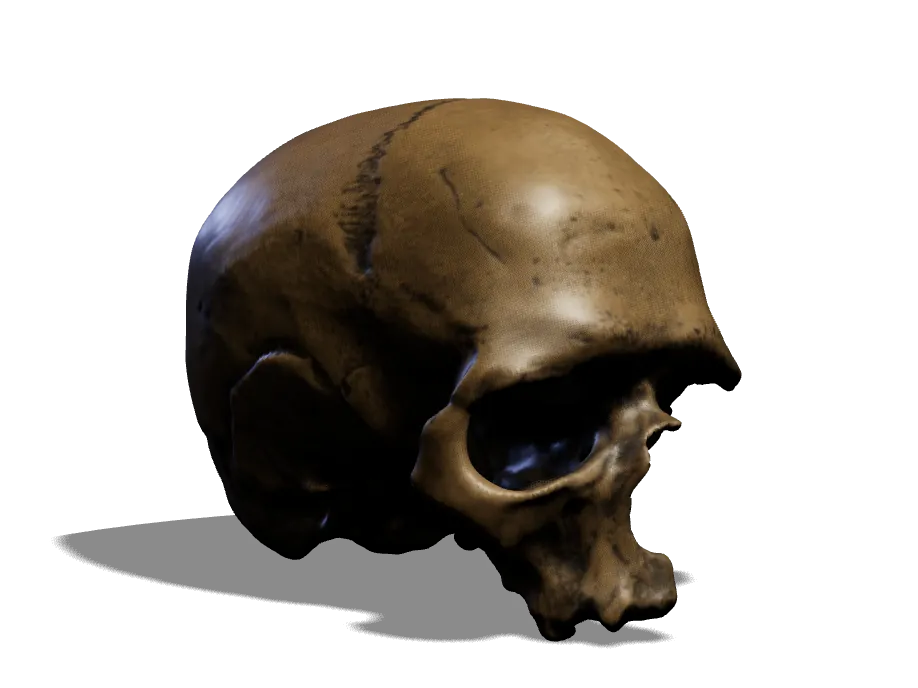
A tan cast of a tall, rounded skull without its lower jaw, with a nearly vertical forehead, no heavy brow ridge, and a face that does not jut forward.
Homo sapiens · cast, scanned in 3D
Cro-Magnon 1, Homo sapiens
- Object
- Cast of the skull of a middle-aged man, without the jaw
- Date
- Probably 32,000 to 30,000 years old; found 1868
- Place
- Cro-Magnon rock shelter, Les Eyzies, France
- Material
- Cast of fossil bone
- Collection
- Service de biologie du comportement, University of Liège
One of the first fossils recognised as our own species, and among the oldest Homo sapiens in Europe. Compare the forehead and brow with the Neanderthal's.
A tall, rounded skull
The skull is tall and rounded with a near-vertical forehead. No large brow ridge tops the eye sockets, and the face and jaw don't jut forward. Source: Smithsonian Human Origins, “Cro-Magnon 1”.
A hard life
The bones of his face are pitted from a fungal infection. Others buried in the shelter had injured necks, and a woman had lived for some time with a skull fracture. Source: Smithsonian Human Origins, “Cro-Magnon 1”.
3D scan: Service de biologie du comportement, University of Liège (ULiège), via Sketchfab · CC BY 4.0
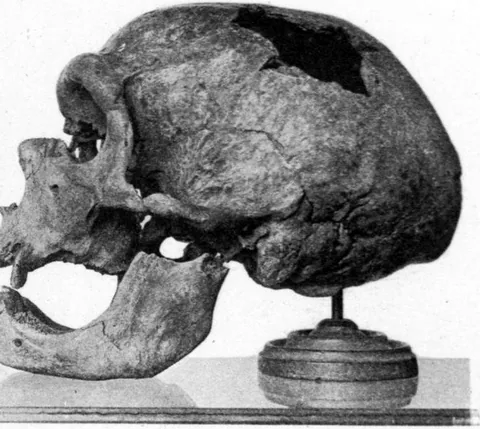
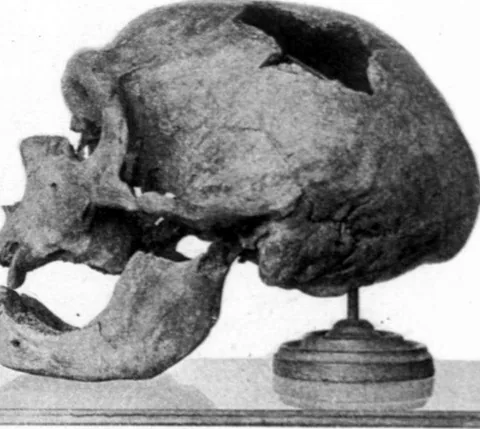
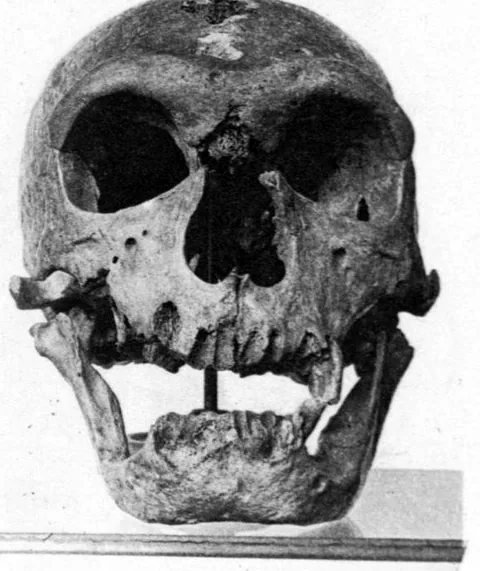
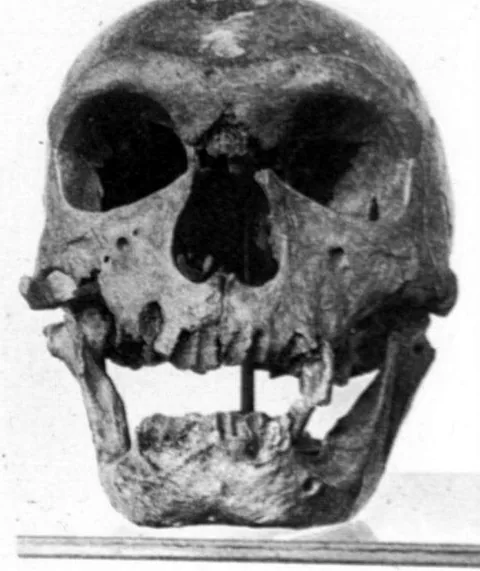
Two old photographs of a heavy fossil skull with its jaw, seen from the side and from the front: a long, low braincase, a big brow ridge, large eye sockets and nasal opening, and few teeth.
The same fossil, photographed in 1911
La Chapelle-aux-Saints 1
- Object
- Skull and jaw of a Neanderthal man
- Date
- About 60,000 years old; photographed 1911
- Place
- La Chapelle-aux-Saints, France
- Material
- Fossil bone; heliogravure plate
- Collection
- Annales de Paléontologie VI (1911), plate XVII
Found in 1908, the first fairly complete Neanderthal skeleton anyone had seen. Boule reconstructed him in 1911 as a stooped brute, and popular culture kept that picture for decades. Later study of the skeleton did not support it.
Boule's reading
Boule read the big brow and low vault as signs of a primitive, dim creature. The Smithsonian's account puts that reading down to his own preconceptions. Source: Smithsonian Human Origins, “La Chapelle-aux-Saints”.
Photographs: Marcellin Boule, Annales de Paléontologie, 1911 · Public domain
.jpg)
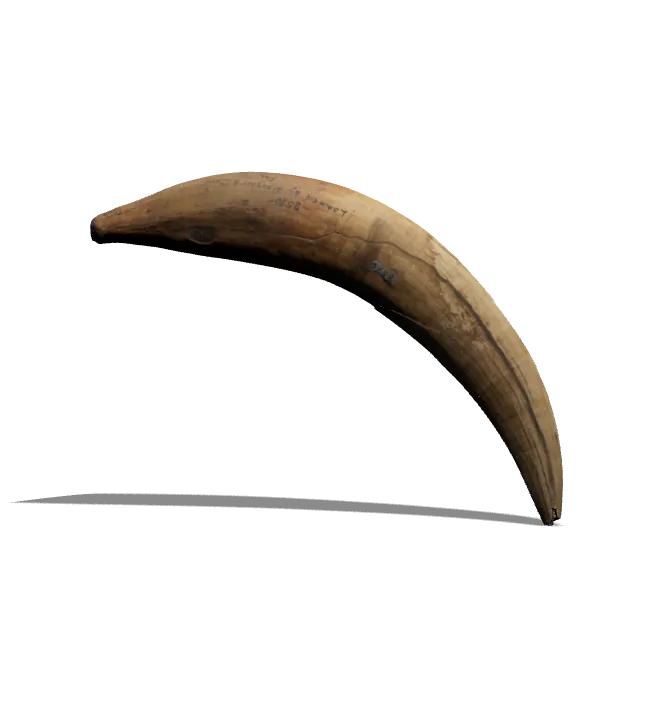
A long, curved, blade-like fossil tooth, pale tan to brown, with a museum number inked on its side.
Fossil, scanned in 3D
A sabre-toothed cat's canine
- Object
- Upper canine of Smilodon fatalis, a sabre-toothed cat
- Date
- Pleistocene (the Ice Ages)
- Place
- California, United States
- Material
- Fossil tooth
- Collection
- Smithsonian National Museum of Natural History, Paleobiology, USNM V 8570
While the other humans lived in Europe and Asia, this cat hunted in North America. Its long upper canines are the sabres of its common name, the sabre-toothed cat.
Thin edges, fine serrations
The upper canines taper, with compressed front and back edges and small serrations along them. One study suggests these helped them pierce hide as the jaws closed. Source: Brown, “Jaw function in Smilodon fatalis”, PLOS ONE 9 (2014).
The museum's number
The number inked on the tooth, 8570, matches the Smithsonian catalogue entry USNM V 8570: Smilodon fatalis, from the Pleistocene of California. Source: Smithsonian NMNH, USNM V 8570 (via GBIF).
The tar pits
More than 2,500 of these cats have been recovered from the La Brea Tar Pits in Los Angeles. Source: La Brea Tar Pits, “Saber-toothed cat 101”.
Gallery 02 · Room 3 · Hands on
Two lineages in one bone
Denisova 11 is a small bone fragment from Denisova Cave in Siberia, more than 50,000 years old, from a girl at least 13 years old. In 2018 researchers read its DNA two fragments at a time, at places where Neanderthal and Denisovan genomes differ. Draw the pairs yourself.
0 pairs drawn from Denisova 11
Why 50%, not 100%: half the time both fragments come from the same copy of a chromosome, so even a first-generation child shows one of each in only about half the draws.
The published result
| Bone | One of each | Both Neanderthal | Both Denisovan |
|---|---|---|---|
| Denisova 11 | 43.5% | 27.3% | 29.2% |
| A Neanderthal (Goyet Q56-1) | 2.1% | 90.3% | 7.5% |
Known Denisova 11 had a Neanderthal mother and a Denisovan father. Her mitochondrial DNA, which came from her mother, is of the Neanderthal type.
The draws here are simulated from the proportions in Slon et al. (2018), Figure 2c. The paper's own test used the genomes of the Altai Neanderthal and Denisova 3.
Gallery 02 · Room 4 · Reconstructions
Stills from the reel
Frames from the film: reconstructions and illustrations, not photographs of the objects. Tap or hover to look closer.
01 A lineage known through DNAFarther east were Denisovans, a human lineage known mostly through DNA and a small fossil record. 02 One bone, two lineagesOne bone from Denisova Cave belonged to a girl with a Neanderthal mother and a Denisovan father.
Records
Sources for this gallery
- Slon et al., “The genome of the offspring of a Neanderthal mother and a Denisovan father”, Nature 561 (2018)
- Smithsonian Human Origins, “La Chapelle-aux-Saints”
- Smithsonian Human Origins, “LB-1”
- Smithsonian Human Origins, “Homo floresiensis”
- Smithsonian Human Origins, “Cro-Magnon 1”
- Brown, “Jaw function in Smilodon fatalis”, PLOS ONE 9 (2014)
- Smithsonian NMNH, USNM V 8570 (via GBIF)
- La Brea Tar Pits, “Saber-toothed cat 101”
Credits
- Narration, edit and imagery: Then & Theory / Alterra Editions. Images on this page are illustrations from the reel, not photographs of specimens.
- La Chapelle-aux-Saints 1: 3D scan: Service de biologie du comportement, University of Liège (ULiège), via Sketchfab (CC BY 4.0). Museum record.
- LB1, Homo floresiensis: 3D scan: Service de biologie du comportement, University of Liège (ULiège), via Sketchfab (CC BY 4.0). Museum record.
- Cro-Magnon 1, Homo sapiens: 3D scan: Service de biologie du comportement, University of Liège (ULiège), via Sketchfab (CC BY 4.0). Museum record.
- La Chapelle-aux-Saints 1: Photographs: Marcellin Boule, Annales de Paléontologie, 1911 (Public domain). Museum record.
- A sabre-toothed cat's canine: 3D scan: Smithsonian Institution (CC0 1.0). Museum record.