How we know
Every date, cause of death and family tree in our cases comes from a method, and every method has limits. Here are five to try for yourself.
Exhibit 01
Radiocarbon dating
Cosmic rays striking nitrogen in the air make carbon-14, and living things take it in with the rest of their carbon. When a plant or animal dies, it stops taking carbon in and its carbon-14 decays. Half is gone after 5,730 years.
Willard Libby proposed the method in 1946 and tested it on things of known age: tree rings, and timber from the funeral boat of the pharaoh Senusret III. It can now date material up to about 50,000 years old.
A lab's result is not yet a calendar date. It is reported in years “before present”, meaning before 1950, as if the air's carbon-14 had never changed and using Libby's first half-life, 5,568 years. Neither is quite true, so dates are calibrated against tree rings, whose years are known, and other records. The answer is a range: Oxford's example, a sample measured at 3000 ± 30 BP, comes out between 1375 and 1129 BC, at 95% confidence.
Try it: let a sample age
50%of its carbon-14 left
Each dot: 1% of the carbon-14 it had alive
Exhibit 02
Ancient DNA
DNA starts to fall apart when its owner dies. What survives comes out in short, damaged pieces, mixed with modern DNA from anyone who touched the bone, and reading it destroys part of the sample.
It lasts best where it is very cold and dry: in permafrost and caves. The oldest human DNA read so far is from a Neanderthal about 400,000 years old; mammoth DNA from the Siberian permafrost is over a million years old. For most of human evolution our ancestors lived in the tropics and subtropics, where it rarely survives.
Where it does survive, it can reach people alive today. Europeans and Asians carry about 1 to 4% Neanderthal DNA; Melanesians and Aboriginal Australians carry about 3 to 5% Denisovan DNA.
Try it: what can a bone tell us?
Diagram: whole where DNA was read, scattered where none was recovered.
50,000 to 30,000 years old
- What it told us
- A girl from a kind of human no one had seen before. The Denisovans are the first ancient humans known from their genes alone; the genome was published in 2010.
- What it couldn't
- What she looked like. A few bones and teeth are all the Denisovans have left, too few to compare their genome properly with ours.
Source: Australian Museum, “The Denisovans”; Smithsonian Human Origins, “Ancient DNA and Neanderthals”
About 90,000 years old
- What it told us
- A girl at least 13 years old, with a Neanderthal mother and a Denisovan father. Protein tests picked the bone out of over 2,000 unidentified fragments; then its DNA was read.
- What it couldn't
- How often such meetings happened. One child shows that they did.
At least 160,000 years old
- What it told us
- Denisovan, going by its proteins. It helps explain why some Tibetans carry Denisovan genes.
- What it couldn't
- Its DNA. None could be extracted, so the identification rests on proteins.
Fossils 100,000 to 60,000 years old
- What it told us
- Nothing yet. No DNA has been recovered from its bones.
- What it couldn't
- Where it sits in the family tree. Humans spent most of their evolution in the tropics and subtropics, where DNA rarely survives.
Source: Smithsonian Human Origins, “Homo floresiensis”; Natural History Museum, “Homo floresiensis”; Smithsonian Human Origins, “Ancient DNA and Neanderthals”
Radiocarbon-dated remains, the last about 4,000 years old
- What it told us
- Fewer than ten mammoths founded the island's herd; it grew to about 300 breeding animals and carried harmful mutations for thousands of years.
- What it couldn't
- What finally killed them. The genomes show a fast decline at the very end, and no cause.
About 5,300 years old
- What it told us
- His genome has been almost fully read. His ancestors came from Anatolia about 8,000 years ago. He had dark hair, dark eyes and medium to dark skin, and was lactose intolerant.
- What it couldn't
- Who shot him, or why.
Exhibit 03
X-rays and CT
An X-ray sees through what can't be opened. For ten years after he was found, Ötzi was thought to have died in an accident. In 2001 an X-ray showed a flint arrowhead in his left shoulder. Then a 2 cm entry wound was found in his back: the arrow had cut an artery under the collarbone, and he bled to death within minutes.
Inside a lump of corroded bronze from the Antikythera wreck were gearwheels. X-rays of its fragments, made by Charalambos and Emily Karakalos, let the physicist Derek de Solla Price identify 30 surviving gears. In 2005, X-ray computed tomography, CT, took the 82 fragments slice by slice. It decoded the gearing at the back and found inscriptions describing the motions of the Sun, the Moon and the five planets known in antiquity.
Try it: run the scan
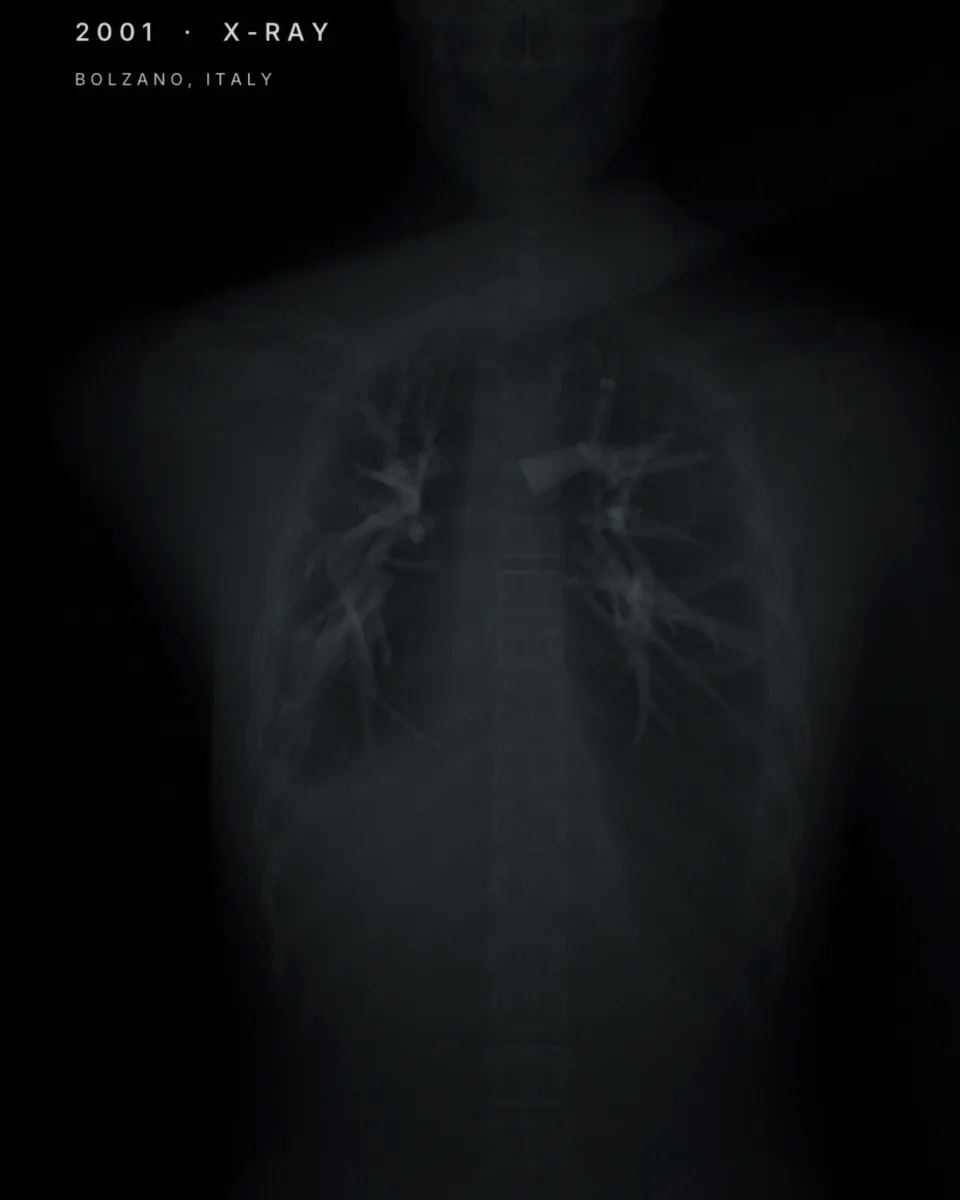
Reconstruction of a chest X-ray, not the 2001 image. The mark shows roughly where the arrowhead lies; we placed it.
Exhibit 04
Reading the layers
In 1669 Nicolaus Steno set out the rule now called superposition: layers settle one on another, so each is older than the one above it and younger than the one below. He also saw that layers are laid down nearly flat, so a tilted or folded layer was moved after it formed.
Archaeologists dig by the same rule. The layers give an order, not an age in years; the years come from other methods, such as radiocarbon dates on what each layer holds.
The section here is the National Park Service's teaching example, not a real site.
Try it: dig down
- GrassToday
- A city parkEarly 20th century
- A town1890s
- An explorers' base1650s
- Flood siltEarly 1500s
- A hunting campAbout 2,000 years ago
- River siltBefore anyone
Grass, today
The surface. The archaeological sites of the future are being made here.
No finds in this layer.
A city park, early 20th century
Rides of metal and plastic; things dropped by visitors.
- Coins
- Keys
- Keychains
- Jacks
- Buttons
- Hairpins
A town, 1890s
Houses built by free Black families; toys left by their children.
- Nails
- Clay chinking
- Doll parts
- Marbles
An explorers' base, 1650s
Tents, horses and guns of Spanish explorers.
- Nails
- Bridle hardware
- Ammunition
- Pencil pieces
- Metal pots
- Buttons
Flood silt, early 1500s
The river flooded and left a thick layer of silt and rock. No one lived in it, so it holds nothing.
No finds in this layer.
A hunting camp, about 2,000 years ago
Native Americans returning to a traditional hunting spot by the river.
- Fire-cracked rock
- Stone points
- Fishhooks
- Pottery
River silt, before anyone
Grey silt and rocks from the river. The bottom of the site.
No finds in this layer.
Exhibit 05
Reading old sources
Much of what is said about the Library of Alexandria's end comes from writers who lived long after it. Three different destructions are told: Caesar's fire in 48 or 47 BC, the sack of the Serapeum in AD 391, and the Arab conquest of 641. Each account has problems.
So we ask of every source when it was written, how far from the events, what its words actually say, and whether anything else backs it up. A late or doubtful source is flagged in our scripts, and the claim is worded to match.
The historian Roger Bagnall argues for something less dramatic: slow neglect and decay. He points to the early 270s AD, when much of the city was destroyed in fighting, as the likeliest time for library buildings to have been wrecked. Some historians give more weight to single destructions.
Try it: how far from the event?
The event it describes When it was written
Plutarch, Life of Caesar 49
- About
- Caesar's fire
- Written
- At least a century after
- Says
- Caesar's fire “spread from the dockyards and destroyed the great library”.
- Watch for
- Short on detail, and written a century or more later. Nobody knows where the library stood, so nothing confirms the fire reached it.
Cassius Dio, Roman History 42.38.2
- About
- Caesar's fire
- Written
- Probably early in the 3rd century AD
- Says
- Books burned in the fire.
- Watch for
- Read closely, his Greek is about books in warehouses, which may have held grain as well. That may not be the library at all.
Ammianus Marcellinus, Histories 22.16
- About
- Caesar's fire
- Written
- In the 4th century AD
- Says
- The library burned in Caesar's war, and he ties it to a temple, the Serapeum.
- Watch for
- The Serapeum stood well away from the harbour and the palace, so which library he means is unclear.
Edward Gibbon, The Decline and Fall of the Roman Empire
- About
- The sack of the Serapeum, AD 391
- Written
- In the 1770s and 1780s
- Says
- The library rose again in the Serapeum and was destroyed when Christians sacked the temple in 391.
- Watch for
- Written nearly 1,400 years after the event, by a historian of the Enlightenment for whom the loss of learning mattered deeply.
Bar Hebraeus (Abu'l-Faraj), Chronicum Syriacum
- About
- The Arab conquest, AD 641
- Written
- About six centuries after
- Says
- The conquerors burned the books in the city's baths for six months.
- Watch for
- The story first appears six centuries after the event. Scholars widely agree it is fiction.